
Applications of the Industrial Videoscope in Railway Locomotive and Rolling Stock Inspection
Category: Railway-
On: 2026-09-20
Railway locomotives and rolling stock generally include various types of vehicles used in railway transportation, such as electric locomotives, diesel locomotives, passenger coaches, and railway freight cars. As important components of railway passenger and freight transportation, locomotives and rolling stock operate under high-speed movement, continuous vibration, and complex environmental conditions. Their internal mechanical components, electrical equipment, transmission systems, and braking systems therefore require regular inspection and maintenance.
As the number of railway lines and vehicles continues to increase, improving inspection efficiency while maintaining maintenance quality has become an important consideration in railway equipment maintenance. Some components are located inside complex structures or confined spaces that are difficult for inspectors to observe directly. Traditional disassembly-based inspection can require significant time and may increase the workload associated with equipment removal and reassembly.
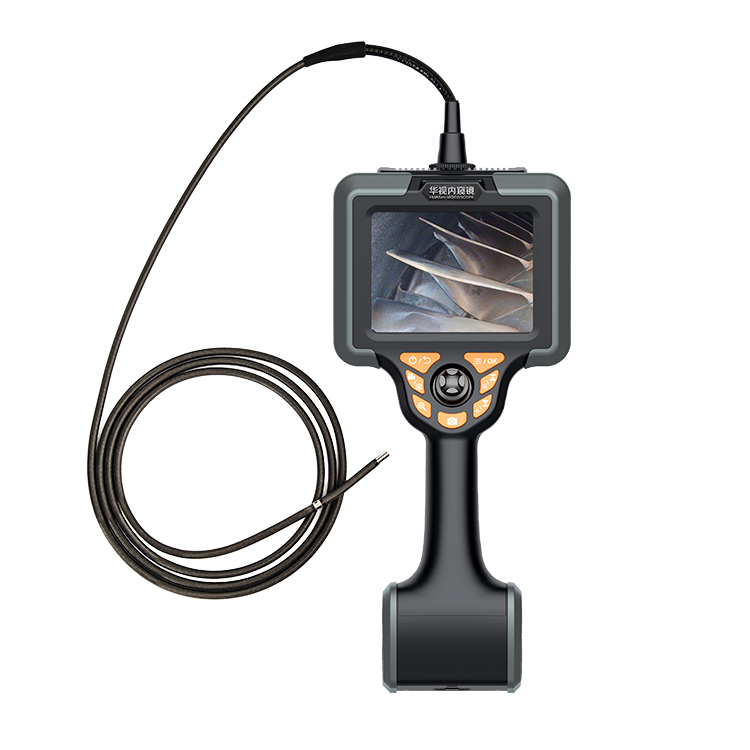
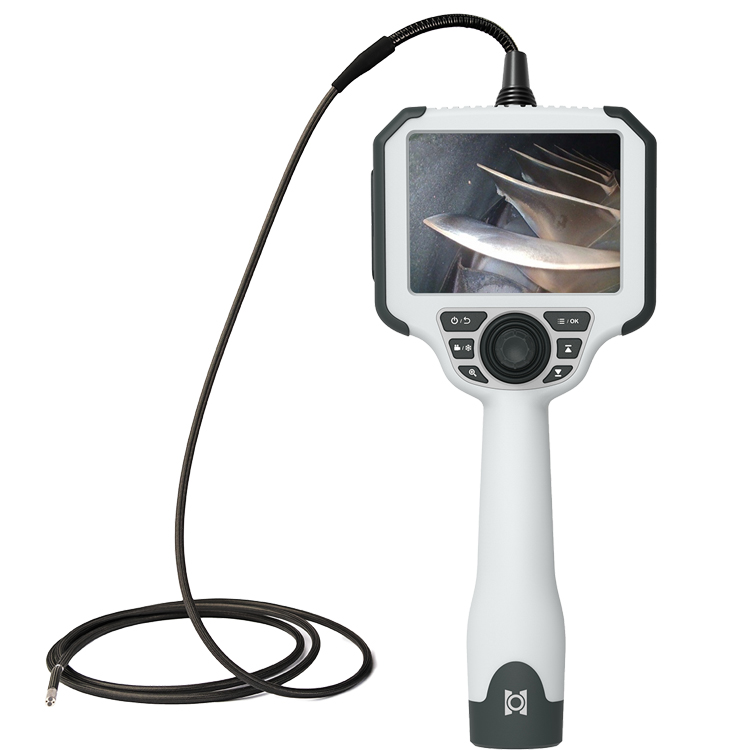
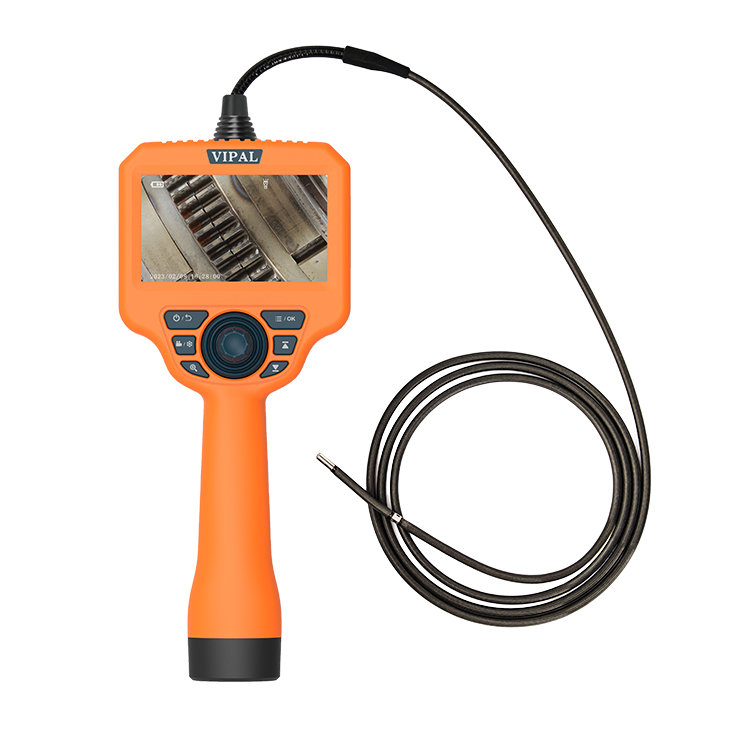
An industrial videoscope provides a practical visual inspection method for these applications. By inserting a flexible probe into the equipment, inspectors can observe internal components, capture images and videos, and assess visible conditions with no or minimal disassembly where the equipment design and maintenance procedures permit.
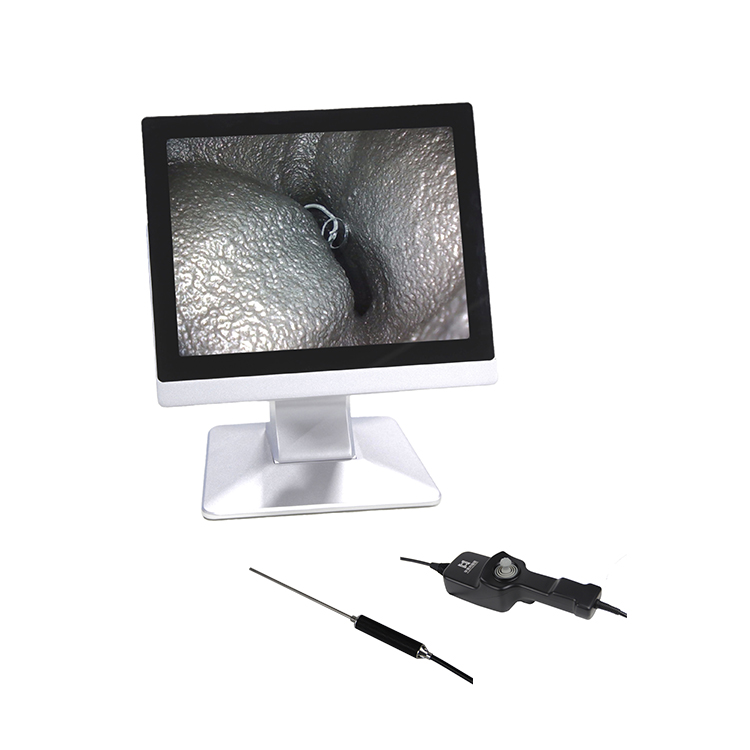
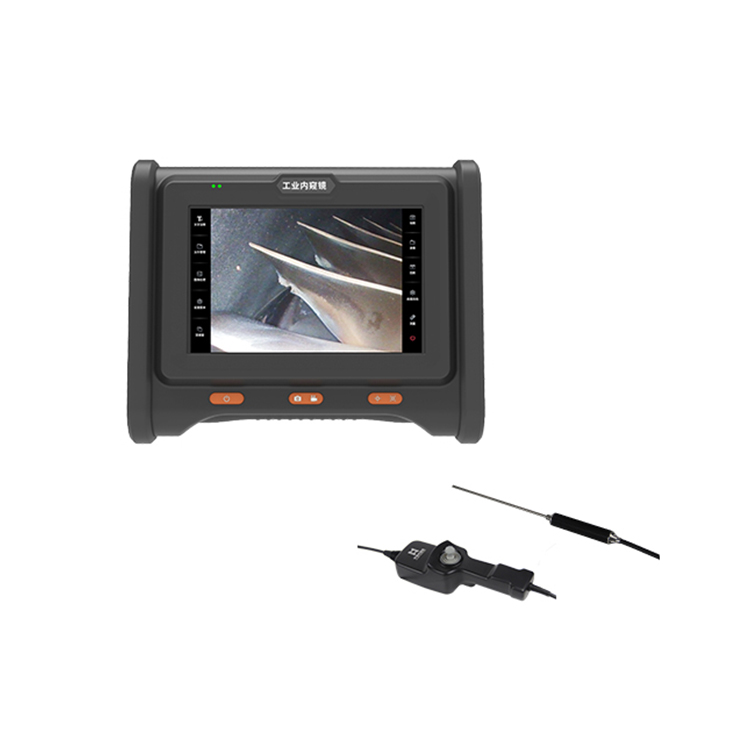
The G10 Industrial Videoscope is designed for industrial inspection applications and features high-resolution imaging, interchangeable probes, flexible operation, on-screen viewing, and image and video recording. Different probe diameters and lengths can be selected according to the inspection location, providing a flexible visual inspection solution for railway locomotives and rolling stock.
1. Traction Motor Internal Inspection
The traction motor is an important component of the propulsion system of railway locomotives and rolling stock. During long-term operation, it can be affected by vibration, temperature rise, dust, and mechanical wear.
During maintenance, depending on the equipment design, the G10 probe can be inserted into the motor through maintenance openings, inspection ports, or cooling passages.
The real-time high-resolution images provided by the G10 can help inspectors examine areas that are difficult to observe directly, including:
* The surface of the commutator for contamination, burning, or abnormal wear
* Carbon brush condition, including abnormal wear or sticking
* Bearings and surrounding areas for signs of abnormal wear
* Foreign objects or visible mechanical damage inside the motor
* Other internal areas that are difficult to observe directly
During the inspection, maintenance personnel can view the internal condition directly on the G10 display and capture photos or videos when required. These records can provide supporting information for subsequent maintenance decisions and inspection documentation.
2. Traction Gearbox Inspection
The traction gearbox operates under significant mechanical loads and is an important component of the transmission system of railway vehicles.
Traditional inspection methods may involve oil inspection and disassembly-based examination. For some initial condition assessments, an industrial videoscope can first be used for a visual inspection.
The G10 Industrial Videoscope can be inserted through inspection openings or oil-level inspection ports on the gearbox to observe gears, bearings, and accessible areas at the bottom of the gearbox.
Key inspection points may include:
* Abnormal wear on gear surfaces
* Pitting, spalling, or other visible surface damage on gear teeth
* Visible abnormalities in gear meshing areas
* Abnormal conditions around bearings and related components
* Metal particles or other foreign objects inside the gearbox
For confined gearbox interiors, flexible probe control can help inspectors adjust the viewing direction and observe internal components from different positions, potentially reducing the need for some initial disassembly inspections.
3. Hollow Axle and Related Component Inspection
Hollow axles are used in high-speed trains and certain railway vehicles. Their design can help reduce unsprung mass and contribute to vehicle operating performance.
Because the internal space of a hollow axle can be relatively long and narrow, direct visual inspection can be difficult. Certain early-stage surface conditions, such as corrosion, wear, suspected cracks, or other abnormalities, may not be easy to observe using conventional methods.
Depending on the inspection opening, an appropriate G10 probe diameter can be selected and inserted into the hollow axle to inspect its internal surfaces.
High-resolution images can help inspectors identify visible conditions such as:
* Corroded areas
* Abnormal surface wear
* Suspected cracks
* Scratches and other surface indications
* Foreign objects or other visible abnormalities
When a suspected indication is found, high-resolution images can be captured and saved for further review and comparison as part of the applicable inspection procedure.
4. Diesel Engine Cylinder Inspection
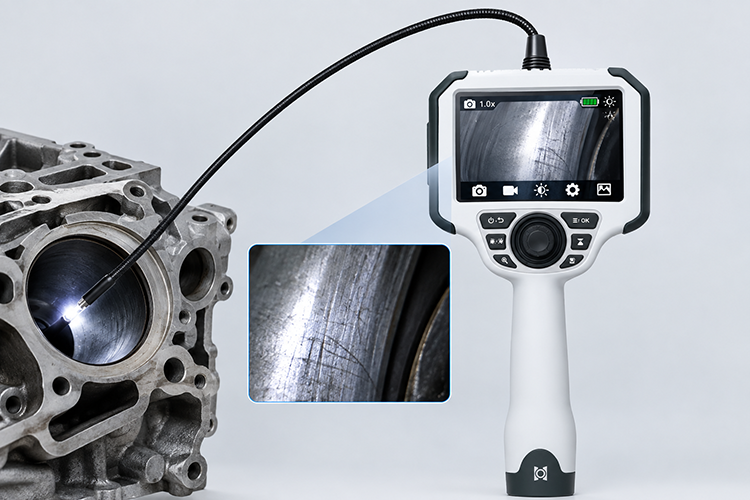
For diesel locomotives, the inside of the diesel engine cylinder is another potential application for industrial videoscope inspection.
Where permitted by the equipment design and applicable safety and maintenance procedures, the industrial videoscope probe can be inserted through an injector opening, spark plug opening where applicable, or another suitable inspection port to examine the piston crown, cylinder wall, and valve areas.
The G10 Industrial Videoscope can help inspectors observe:
* Carbon deposits on the piston crown
* Cylinder wall surface condition
* Valve and exhaust areas
* Visible abnormalities inside the combustion chamber
* Suspected wear, scratches, or other surface indications
Compared with conventional disassembly-based inspection, a videoscope can provide an initial internal visual assessment before further disassembly is considered when an abnormal condition is identified. This can help make subsequent maintenance inspection more targeted.
5. Braking System and Pipeline Inspection
Railway braking systems are complex and may include brake cylinders, air reservoirs, valves, pipelines, and various auxiliary components.
Some internal structures are difficult to observe directly because of space limitations. Where suitable inspection openings or access passages are available, the G10 Industrial Videoscope can be used as an auxiliary visual inspection tool.
For example, it may be used to observe:
* Visible foreign objects inside components
* Possible blockages or abnormalities inside accessible pipelines
* Visible abnormalities in internal mechanical structures
* Contamination or visible damage inside valves and related components
* Internal conditions in areas that are difficult to observe directly
An industrial videoscope does not replace specialized testing methods required for railway braking systems. It can, however, serve as a supplementary visual inspection tool for quickly checking accessible internal conditions.
6. Bearing, Transmission, and Other Mechanical Component Inspection
In addition to traction motors, gearboxes, and hollow axles, railway locomotives and rolling stock contain numerous bearings, couplings, transmission mechanisms, and other mechanical components.
During long-term operation, these components may be affected by wear, vibration, impact, contamination, and other factors.
Depending on the inspection location, different G10 probe diameters and lengths can be selected. The probe can be inserted through existing maintenance openings, inspection ports, or narrow passages to visually examine accessible internal areas.
In locations where space is limited and disassembly is difficult, an industrial videoscope can serve as an initial condition inspection tool to help maintenance personnel identify visible abnormalities.
7. G10 Configurations for Different Inspection Spaces
Inspection locations on railway locomotives and rolling stock vary considerably. Some areas have very limited access, while others are located deep inside the equipment. A single probe configuration may therefore not be suitable for every application.
The G10 series can be configured with probes of different diameters and insertion lengths according to the actual inspection requirements.
For small access openings and confined spaces, a smaller-diameter probe can be selected. For deeper inspection locations, a longer probe can be used according to the required inspection depth.
This flexibility in probe specifications allows the G10 series to support different internal inspection locations with varying access sizes and depths.
8. High-Resolution Imaging and Inspection Records
Railway locomotive and rolling stock maintenance requires not only visual observation but also inspection documentation and traceability.
The G10 features a high-resolution display system that provides real-time images from the inspection probe. Inspectors can adjust image brightness according to the inspection conditions and capture photos or videos of abnormal areas identified during the inspection.
These inspection records can be used for:
* On-site maintenance assessment
* Fault analysis
* Maintenance documentation
* Before-and-after condition comparison
* Information sharing between technical personnel
* Subsequent quality and inspection traceability
For internal conditions that are difficult to describe accurately with text alone, saved inspection images can provide more direct visual evidence.
9. Industrial Videoscopes and Railway Maintenance Efficiency
Railway locomotive and rolling stock maintenance involves numerous inspection points, complex equipment structures, and high operational requirements.
With traditional inspection methods, if a component must be disassembled before its internal condition can be confirmed, the inspection process may require additional time and labor.
The G10 Industrial Videoscope can, where access and inspection conditions permit, enter equipment through existing openings or maintenance passages and provide an initial visual assessment before further disassembly is considered.
A typical inspection process can be summarized as:
Identify an abnormality → Locate the area → Capture inspection images → Decide whether further inspection or disassembly is required
For this reason, an industrial videoscope is well suited as an auxiliary inspection tool for condition assessment and troubleshooting of railway locomotives and rolling stock.
Railway locomotives and rolling stock contain many components with complex structures, confined spaces, and areas that are difficult to observe directly. As railway maintenance increasingly focuses on inspection efficiency, visual evidence, and condition documentation, industrial videoscopes can serve as an important supplement to conventional inspection methods.
With high-resolution imaging, flexible probes, multiple probe configurations, image recording, and a portable design, the G10 Industrial Videoscope can be used for auxiliary visual inspection of traction motors, gearboxes, hollow axles, diesel engine cylinders, bearings, transmission components, and certain accessible areas of braking systems.
For railway maintenance personnel, the value of an industrial videoscope is not simply to insert a camera into the equipment. It provides a practical way to obtain visual information about internal conditions while minimizing disassembly where permitted, supporting troubleshooting, condition assessment, and maintenance decisions.
In actual applications, the appropriate G10 probe diameter, length, and functional configuration should be selected according to the specific vehicle type, inspection location, access passage, opening diameter, inspection depth, and technical requirements of the component being inspected. The videoscope should also be used together with other professional inspection and testing methods where required.