
What Is an Industrial Borescope? Complete Guide to Borescope Inspection
Category: News-
On: 2026-08-22
What Is an Industrial Borescope? Complete Guide to Borescope Inspection
An industrial borescope is a remote visual inspection (RVI) tool designed to help inspectors see inside areas that are too narrow, deep, dark, or difficult to access with the naked eye.
By combining a miniature camera, illumination system, insertion probe, and display unit, an industrial borescope allows engineers and technicians to inspect the internal condition of engines, turbines, pipes, gearboxes, castings, welds, pressure vessels, and other industrial equipment without unnecessary disassembly.
Today, modern video borescopes have become an important inspection solution for manufacturing, aerospace, automotive, power generation, oil & gas, petrochemical, shipbuilding, and other industries.
In this guide, we will explain what an industrial borescope is, how it works, the main types of borescopes, common applications, important specifications, and how to choose the right borescope for your inspection requirements.
What Is an Industrial Borescope?
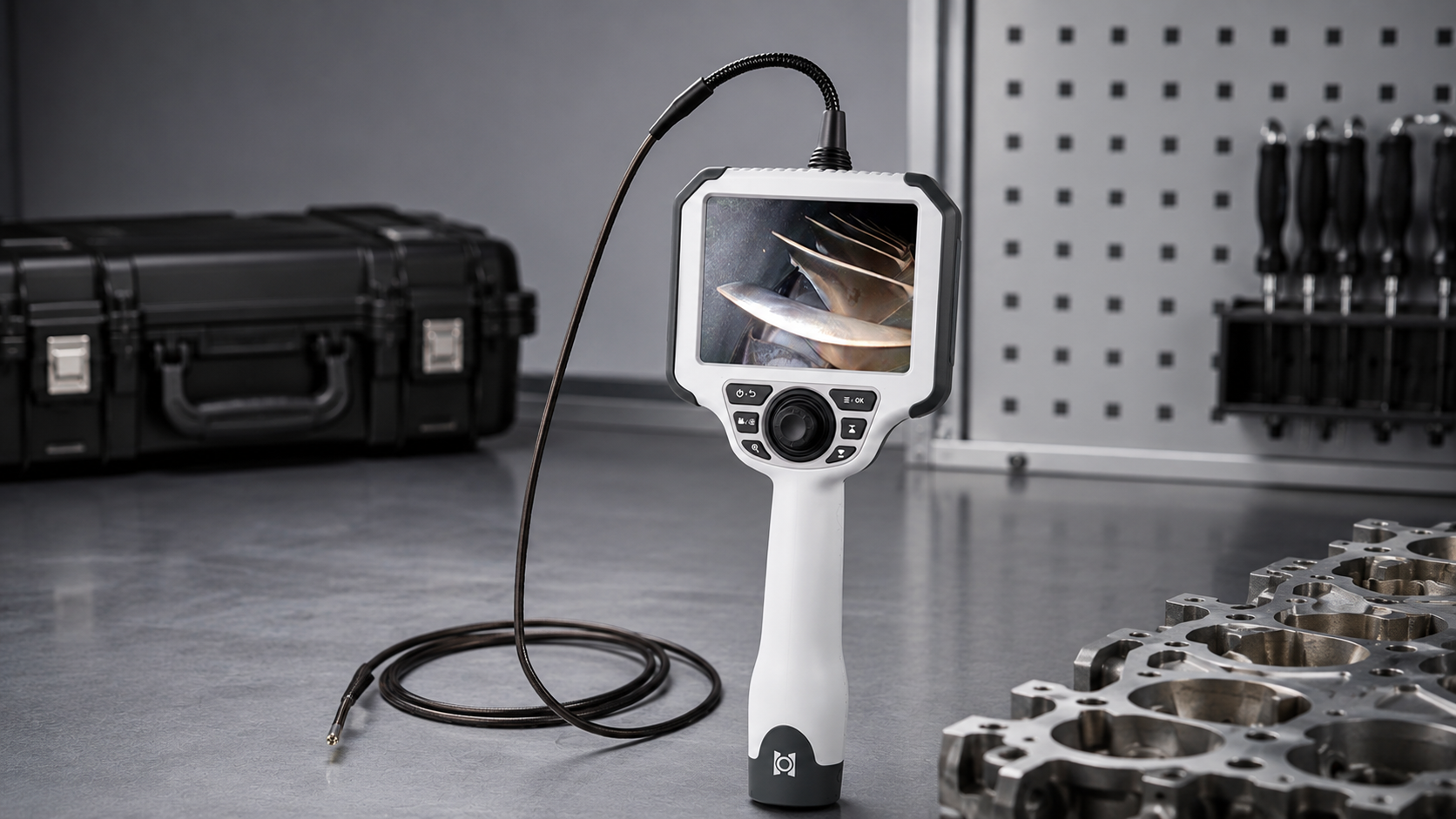
An industrial borescope is an inspection instrument used to visually examine internal areas that are difficult or impossible to access directly.
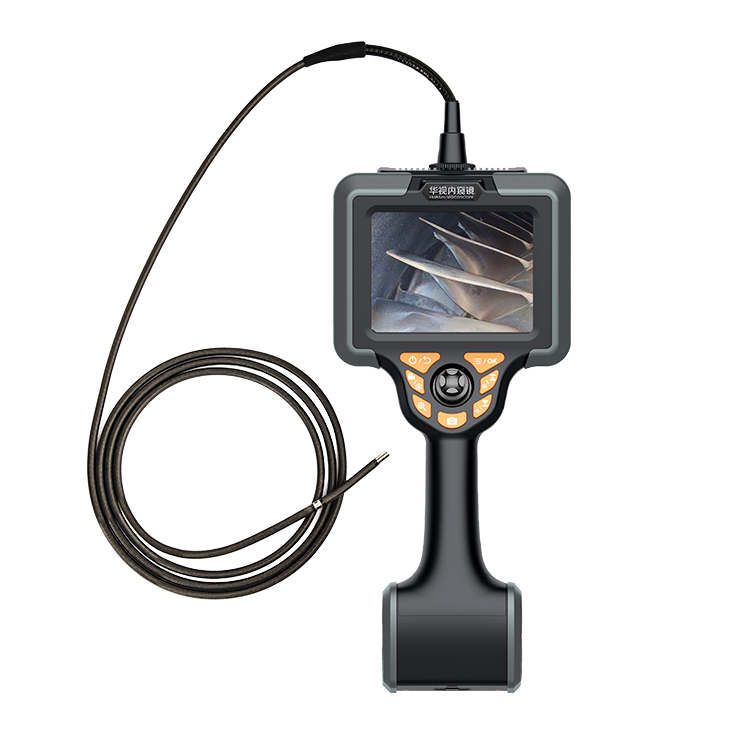
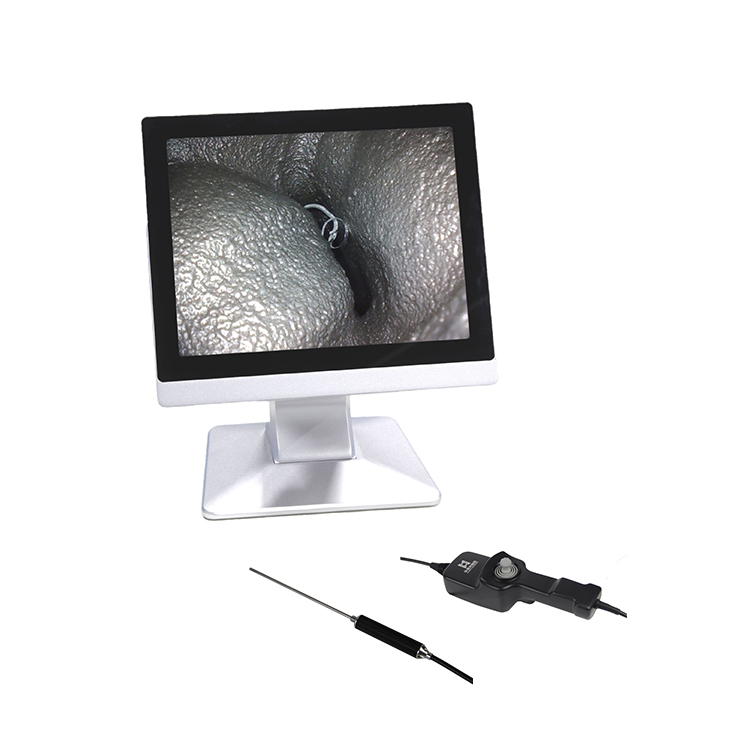
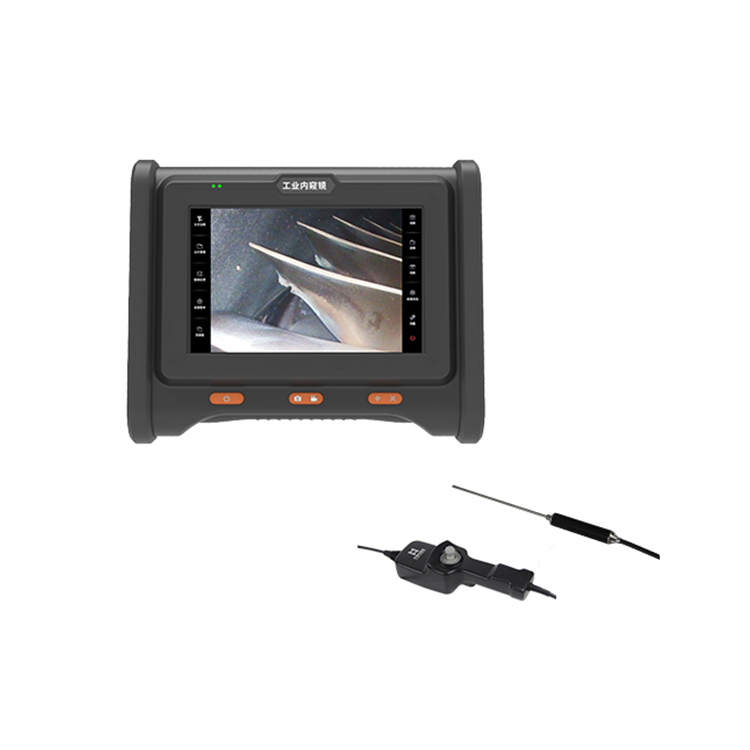
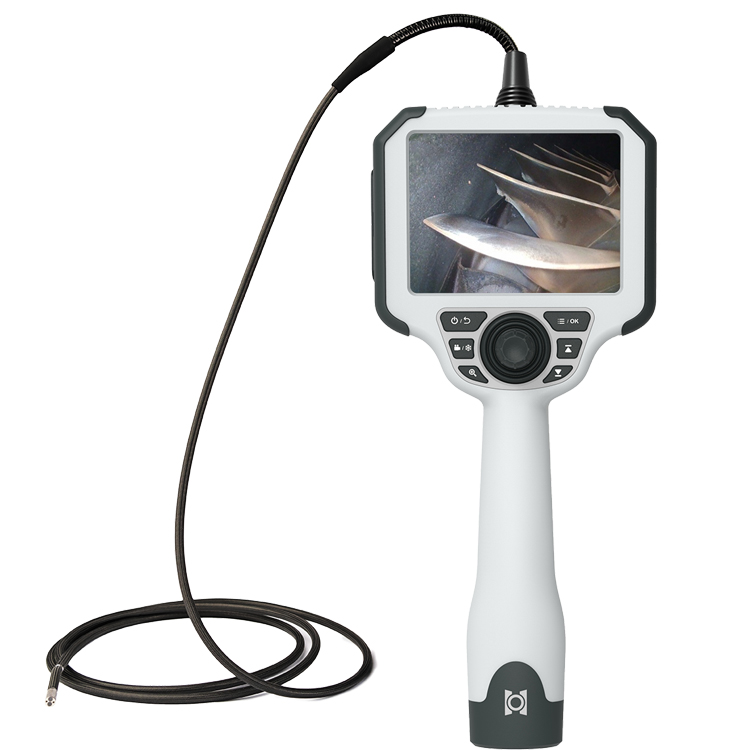
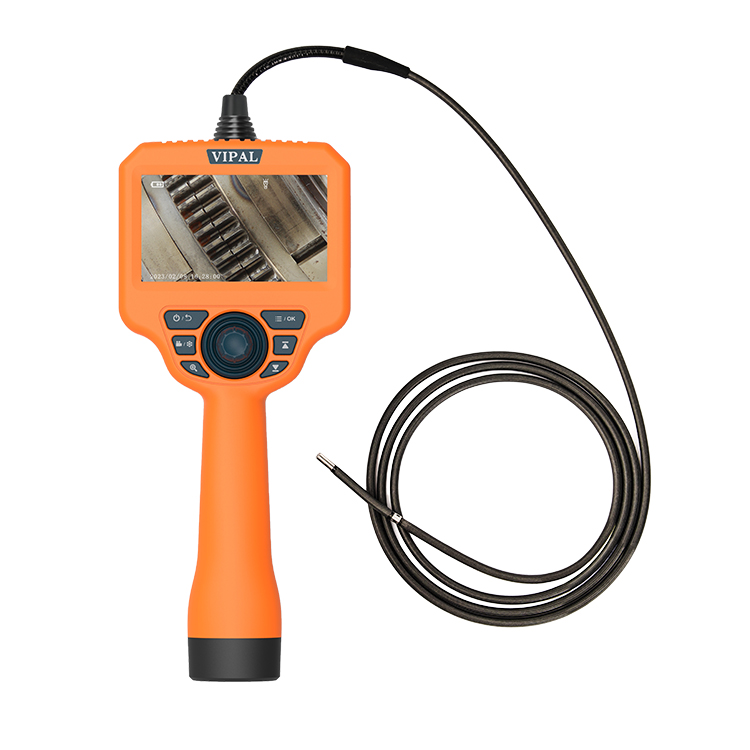
A typical industrial video borescope consists of:
A miniature camera at the probe tip
An LED illumination system
A flexible insertion tube
An articulation mechanism
A handheld display or control unit
Photo and video recording functions
The probe can be inserted through a small inspection opening, allowing the operator to observe internal surfaces in real time.
Unlike conventional inspection methods that may require equipment to be dismantled, a borescope can often provide visual access through an existing inspection port.
This makes borescope inspection a practical solution for remote visual inspection (RVI) and many non-destructive inspection applications.
Modern video borescopes can also provide high-definition imaging, multi-directional articulation, image and video recording, measurement functions, and interchangeable probes.
How Does an Industrial Borescope Work?
The basic working principle of a video borescope is straightforward.
The miniature camera at the end of the insertion probe captures images of the inspection area. The built-in illumination system provides sufficient light inside dark cavities, while the image signal is transmitted through the probe to the main control unit.
The operator can then view the live image on the display.
A typical inspection process looks like this:
Inspection Access → Probe Insertion → Illumination → Image Capture → Image Transmission → Real-Time Inspection → Photo/Video Recording
The articulation system allows the distal tip of the probe to move in different directions. This helps the operator navigate around bends and position the camera toward the area of interest.
For advanced industrial videoscopes, the system may also support functions such as:
High-definition imaging
2-way or 4-way articulation
Digital zoom
Image enhancement
Photo and video recording
Measurement
Image annotation
Dual-camera or dual-view inspection
Interchangeable probes
Wireless data transfer
These functions make modern videoscopes much more than simple inspection cameras.
Borescope vs. Videoscope: What Is the Difference?
The terms borescope and videoscope are often used interchangeably in industrial inspection.
However, technically, they can describe different technologies.
Traditional Borescope
A traditional rigid or optical borescope uses an optical system to transmit the image from the distal end of the instrument to an eyepiece.
Rigid borescopes are particularly useful when the inspection path is relatively straight.
Fiber Optic Borescope
A fiberscope uses a bundle of optical fibers to transmit the image. The flexible probe can navigate curved inspection paths.
Video Borescope
A modern video borescope, also called an industrial videoscope, places a miniature image sensor at the probe tip.
The captured image is transmitted electronically to a display.
This design allows manufacturers to integrate advanced functions such as HD imaging, recording, digital zoom, articulation control, measurement, and image processing.
For many modern industrial applications, video borescopes are preferred because they provide real-time digital images and convenient inspection documentation.
Main Types of Industrial Borescopes
Different inspection environments require different borescope designs.
1. Rigid Borescope
Rigid borescopes use a fixed insertion tube and optical system.
They are suitable for relatively straight inspection paths, such as:
Machined holes
Cylinders
Engine components
Precision mechanical parts
Short internal cavities
Their rigid structure can provide excellent optical clarity when the inspection path is straight.
2. Flexible Borescope
Flexible borescopes use a flexible insertion tube that can pass through curved or complicated paths.
They are useful for:
Pipes
Tubes
Heat exchangers
Complex machinery
Internal cavities
3. Industrial Video Borescope
Industrial videoscopes are widely used for professional remote visual inspection.
They normally combine:
High-resolution camera
Flexible insertion probe
Articulation control
LED lighting
LCD display
Photo/video recording
Depending on the model, a videoscope may also support measurement, interchangeable probes, dual-view cameras, and wireless connectivity.
4. Small-Diameter Borescope
Small-diameter probes are designed for extremely narrow inspection openings.
Common probe diameters include approximately:
0.9 mm
1.2 mm
2.0 mm
3.9 mm
4.0 mm
6.0 mm
8.0 mm
The smaller the probe diameter, the easier it is to enter restricted spaces. However, probe diameter should always be selected according to the required image quality, articulation, length, and inspection environment.
5. High-Temperature Borescope
Some inspection applications involve elevated temperatures.
High-temperature inspection systems are designed for specific operating conditions and may include temperature-resistant probes and appropriate protective measures.
Typical applications include:
Boilers
Furnaces
Turbines
Engines
Industrial heating equipment
The actual allowable temperature depends on the probe construction and operating conditions, so the manufacturer's specifications should always be checked before inspection.
What Are Industrial Borescopes Used For?
The biggest advantage of a borescope is simple:
It allows inspectors to see where their eyes cannot reach.
Industrial borescopes are used across a wide range of industries.
Aerospace and Aviation
Borescope inspection is widely used for examining internal components of aircraft engines and other aerospace systems.
Typical inspection targets include:
Turbine blades
Compressor blades
Combustion chambers
Engine casing
Fuel systems
Internal passages
Inspectors can look for signs of foreign object damage, cracks, corrosion, erosion, overheating, and abnormal wear.
Automotive Inspection
In automotive manufacturing and maintenance, videoscopes can be used to inspect components without extensive disassembly.
Applications include:
Engine cylinders
Combustion chambers
Gearboxes
Transmission systems
Turbochargers
Casting cavities
Oil passages
For manufacturers, borescopes can also help identify casting defects, machining problems, burrs, foreign materials, and surface abnormalities.
Oil & Gas and Pipeline Inspection
Pipelines and process equipment often contain areas that are difficult to inspect from the outside.
Industrial borescopes can help inspect:
Pipeline interiors
Weld areas
Valves
Flanges
Tanks
Pressure vessels
Heat exchangers
Process equipment
Depending on the application, operators may use long-reach probes or small-diameter probes to access deeper or narrower areas.
Power Generation
Borescope inspection is commonly used in power-generation equipment.
Typical inspection targets include:
Gas turbines
Steam turbines
Generators
Boilers
Heat exchangers
Gearboxes
Regular visual inspection can help identify abnormal conditions before they develop into more serious equipment problems.
Wind Power
Wind turbine components can contain complex internal structures that are difficult to inspect directly.
Industrial videoscopes can be used for:
Gearbox inspection
Bearing inspection
Gear inspection
Shaft inspection
Lubrication system inspection
A borescope can allow technicians to examine internal components through relatively small access openings, helping reduce inspection time and unnecessary disassembly.
Manufacturing and Casting
Industrial borescopes are also valuable during manufacturing and quality control.
They can inspect:
Castings
Machined parts
Internal holes
Cooling channels
Welds
Mold cavities
Internal passages
Manufacturers can use videoscopes to identify:
Cracks
Burrs
Porosity
Foreign materials
Machining defects
Corrosion
Surface damage
This makes industrial videoscopes useful not only for maintenance but also for quality inspection and production control.
What Defects Can a Borescope Detect?
A borescope does not replace every NDT method, but it provides an efficient way to visually examine internal surfaces.
Depending on the inspection environment and image quality, operators may identify:
Cracks
Surface cracks and visible fractures may be observed during visual inspection.
Corrosion
Rust, pitting, oxidation, and other visible corrosion conditions can be documented.
Wear
Abnormal wear on gears, bearings, cylinders, and other components may be visible.
Foreign Object Damage
Foreign materials, broken components, debris, and other objects can be located inside machinery.
Burrs and Machining Defects
Borescopes can help manufacturers inspect internal machined surfaces and identify burrs or other visible processing defects.
Blockages
Pipes, channels, holes, and passages can be inspected for blockage or contamination.
Surface Damage
Scratches, deformation, erosion, deposits, and other visible abnormalities can be documented.
Key Specifications to Consider When Choosing a Borescope
Choosing an industrial borescope should start with the inspection requirement rather than simply the camera resolution.
Here are the most important specifications to consider.
1. Probe Diameter
Probe diameter determines how small an access opening the borescope can enter.
For example:
Small diameter → Better access to restricted areas
Larger diameter → Potentially more room for imaging, lighting, articulation, and mechanical construction
The smallest possible probe is not always the best choice. The diameter should be selected according to the actual inspection opening and required image performance.
2. Probe Length
Probe length determines how deep the borescope can reach.
Common industrial probe lengths range from approximately 1 meter to several meters, while specialized long-reach systems can be considerably longer.
When selecting a probe, consider:
Inspection depth
Cable management
Probe flexibility
Articulation performance
Storage and transportation
3. Articulation
Articulation determines how effectively the probe tip can be controlled.
Depending on the design, industrial videoscopes may provide:
2-way articulation
4-way articulation
360° steering
Electric articulation
Better articulation can make it easier to inspect complex internal structures and position the camera toward the target.
4. Camera Resolution
Image resolution directly affects the inspector's ability to identify small visual details.
Depending on the application, available systems may range from basic inspection cameras to high-resolution HD and advanced digital imaging systems.
However, resolution should not be considered alone.
Image quality = sensor + optics + illumination + image processing + viewing angle
A higher pixel count does not automatically guarantee a better inspection image.
5. Illumination
The inside of an engine, pipe, gearbox, or casting is often completely dark.
A high-quality illumination system is therefore critical.
Important factors include:
Light intensity
Brightness adjustment
Light distribution
Color rendering
Reflection control
Good lighting can make a significant difference when inspecting metallic surfaces, cracks, corrosion, and other small defects.
6. Field of View and Depth of Field
Field of view determines how much of the inspection area can be seen at once.
Depth of field determines how much of the image remains in focus at different distances.
These specifications should be selected according to the inspection target.
7. Waterproof and Environmental Protection
Industrial inspection can involve oil, water, dust, humidity, and other harsh conditions.
For this reason, the protection rating of the main unit and probe should be considered.
For example, some industrial videoscopes use waterproof probe assemblies suitable for inspection in wet environments.
Always check the manufacturer's IP rating and environmental specifications before using the equipment in demanding conditions.
8. Image and Video Recording
Recording is particularly important for professional inspection.
Instead of relying only on what the inspector sees during the inspection, recorded images can be:
Reviewed later
Shared with engineers
Included in inspection reports
Compared with previous inspections
Used for maintenance records
Shared with customers
This turns the borescope from a simple viewing device into a useful inspection documentation system.
How to Perform a Borescope Inspection
A typical industrial borescope inspection can be divided into several steps.
Step 1: Define the Inspection Target
Determine what needs to be inspected and identify the available access point.
Step 2: Select the Probe
Choose the appropriate:
Probe diameter
Probe length
Articulation
Camera
Viewing direction
Environmental rating
Step 3: Check the Equipment
Before insertion, inspect the probe, camera tip, articulation mechanism, connectors, battery, and display.
Step 4: Insert the Probe
Insert the probe carefully through the inspection opening.
Avoid forcing the probe through sharp edges or excessively tight passages.
Step 5: Navigate to the Target
Use the articulation control to guide the camera toward the inspection area.
Step 6: Adjust Lighting and Image
Adjust illumination, focus, zoom, or image settings as necessary.
Step 7: Inspect and Record
Capture photos or videos of important findings.
If available, use measurement or annotation functions to document the condition more clearly.
Step 8: Review the Results
Compare findings with inspection criteria, previous inspection records, drawings, or maintenance requirements.
How to Choose the Right Industrial Borescope?
There is no single borescope that is ideal for every application.
Before purchasing a system, answer these questions:
1. How small is the access opening?
This determines the required probe diameter.
2. How deep is the inspection area?
This determines the required probe length.
3. Is the inspection path straight or curved?
This determines whether a rigid or flexible probe is more suitable.
4. Do you need to inspect around corners?
If yes, consider a probe with 4-way or 360° articulation.
5. What level of image detail is required?
This determines the camera and optical configuration.
6. Will the probe be exposed to water, oil, dust, or high temperatures?
If yes, environmental protection and temperature specifications become critical.
7. Do you need inspection reports?
If yes, choose a system with photo/video recording, image annotation, measurement, and data storage functions.
Why Use an Industrial Borescope?
The main value of a borescope is not simply its camera.
It is the ability to obtain visual information from difficult-to-access areas without unnecessary disassembly.
A professional borescope can help:
Reduce inspection time
Reduce unnecessary equipment disassembly
Minimize downtime
Improve inspection efficiency
Document internal conditions
Identify visible defects at an early stage
Support preventive maintenance
Improve quality control
For large and complex equipment, avoiding unnecessary disassembly can represent a significant saving in both time and maintenance cost.
Industrial Borescope Manufacturer for Professional Inspection
As an industrial borescope manufacturer, worldNDT develops and manufactures video borescope systems for professional remote visual inspection.
Our inspection solutions are designed for applications including:
Aerospace and aviation
Automotive
Oil & gas
Power generation
Wind power
Petrochemical
Machinery
Casting and manufacturing
Pipeline inspection
Shipbuilding
Railway
Research and quality control
Different inspection requirements call for different probe diameters, lengths, articulation systems, imaging configurations, and functions.
worldNDT provides industrial videoscope solutions ranging from compact inspection systems to advanced professional platforms, with options for customized configurations and OEM/ODM cooperation.
If you are looking for an industrial borescope manufacturer, video borescope supplier, or customized RVI inspection solution, our engineering team can help you select a suitable configuration based on your inspection application.
Frequently Asked Questions
Is a borescope the same as an endoscope?
The terms can sometimes be used broadly, but industrial borescopes are designed specifically for inspecting machinery, equipment, pipes, engines, and other industrial structures. Medical endoscopes are designed for medical applications.
What is a video borescope?
A video borescope is an industrial inspection device that uses a miniature camera at the end of a flexible probe to capture and display images in real time.
Can a borescope inspect inside an engine?
Yes. Engine inspection is one of the most common applications for industrial borescopes. Inspectors can examine areas such as cylinders, combustion chambers, turbine blades, and internal passages.
Can a borescope be used for NDT?
Borescope inspection is commonly used as a visual inspection or remote visual inspection method within industrial NDT programs. It is particularly useful when direct visual access is limited.
What probe diameter should I choose?
The probe diameter should primarily be determined by the smallest access opening. However, image quality, articulation, probe length, lighting, and inspection environment should also be considered.
What is the difference between 2-way and 4-way articulation?
A 2-way probe can typically bend in two directions, while a 4-way articulating probe can move in four directions. More flexible articulation generally provides better control when navigating complex internal structures.
Conclusion
An industrial borescope is essentially a remote set of eyes for engineers and inspectors.
By combining a miniature camera, illumination, flexible probe, articulation system, and digital display, modern video borescopes make it possible to inspect internal areas that would otherwise require difficult or time-consuming disassembly.
From aircraft engines and automotive components to pipelines, turbines, gearboxes, castings, and pressure vessels, borescope inspection provides a practical way to obtain visual information quickly and document the condition of critical equipment.
The right borescope depends on the application. Probe diameter, length, articulation, image quality, illumination, environmental protection, and recording capabilities should all be considered before selecting an inspection system.
For professional industrial inspection, choosing the right videoscope is not simply about buying the highest-resolution camera. It is about selecting the right combination of access, imaging, articulation, lighting, durability, and inspection functions for the job.