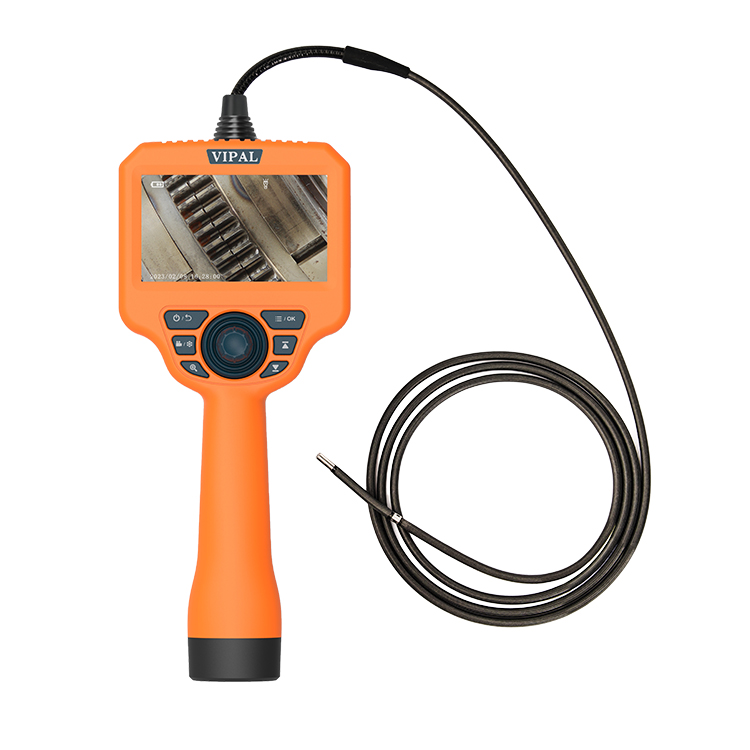

How to Choose the Right Borescope Probe Diameter
Category: News-
On: 2026-08-31
How to Choose the Right Borescope Probe Diameter

Probe diameter is one of the first specifications to consider when selecting an industrial borescope.
The diameter determines whether the probe can physically enter the inspection opening.
However, choosing the smallest possible diameter is not always the best solution.
The right probe must balance accessibility, image quality, lighting, articulation, mechanical strength, and the requirements of the inspection.
What Is Borescope Probe Diameter?
Borescope probe diameter refers to the outside diameter of the insertion tube or distal probe assembly that must pass through the inspection opening.
For example, a 2 mm probe is designed for much smaller access openings than a 6 mm probe.
Before purchasing a borescope, measure the smallest opening through which the probe must pass.
Why Does Probe Diameter Matter?
A smaller probe can access narrower spaces.
This is particularly useful for:
Small engine passages
Precision machinery
Narrow holes
Automotive components
Small internal channels
Compact industrial equipment
Larger probes can provide more internal space for imaging, illumination, articulation, and mechanical protection.
Therefore, the smallest available diameter is not automatically the best option.
Small Diameter Borescopes
Small-diameter borescopes are designed for applications where access is the main limitation.
Depending on the product design, industrial inspection systems can be configured with very small probes as well as larger probes for more demanding applications.
When considering a small-diameter probe, pay attention to:
Image quality
Lighting
Probe flexibility
Articulation
Minimum bending radius
Probe length
Mechanical durability
2mm Borescope vs 4mm Borescope
A 2 mm borescope can access smaller openings than a 4 mm system.
However, a 4 mm probe may provide advantages in applications where the access opening allows a larger diameter.
The decision should therefore be based on the actual inspection requirement.
Choose a smaller probe when:
Access openings are limited.
Internal passages are narrow.
The target is difficult to reach.
Consider a larger probe when:
The access opening is sufficient.
Higher imaging performance is required.
More powerful illumination is beneficial.
Greater mechanical durability is important.
Does Smaller Mean Better?
Not necessarily.
Reducing probe diameter can create engineering challenges.
The available space inside the probe becomes more limited for:
Camera components
Lighting
Articulation
Wiring
Protective structures
For this reason, the best industrial borescope is not necessarily the smallest one.
How to Select the Correct Diameter
Use this simple process:
Step 1: Measure the access opening
Identify the smallest diameter through which the probe must pass.
Step 2: Check the internal path
Make sure the probe can travel through the complete inspection route.
Step 3: Determine the required inspection detail
Consider whether you need to identify small cracks, corrosion, wear, burrs, or other visible defects.
Step 4: Consider articulation
If the camera needs to turn inside the equipment, verify that the selected diameter supports the required articulation.
Step 5: Consider the inspection environment
Water, oil, dust, temperature, and mechanical contact can influence the appropriate probe design.
Probe Diameter Is Only One Specification
A complete borescope selection should also consider:
Probe length
Camera resolution
Lighting
Field of view
Depth of field
Articulation
Environmental protection
Recording
Measurement
The final configuration should be optimized for the complete inspection task.