
Flexible vs. Rigid Borescope: Which Is Better for Industrial Inspection?
Category: News-
On: 2026-09-02
1. Overview of the Two Main Types of Industrial Borescopes
Industrial borescopes are generally divided into two main types based on their insertion tube design: flexible borescopes and rigid borescopes.
Both types allow inspectors to visually examine narrow, enclosed, and hard-to-reach areas without extensive disassembly. However, their structural designs are fundamentally different, resulting in significant differences in inspection path compatibility, operating conditions, and practical advantages.
There is no single "best" borescope for every industrial inspection application. The right choice depends primarily on the internal geometry of the equipment, the shape of the inspection path, and the location of the inspection target.
Selecting the appropriate type according to the actual inspection requirements can improve inspection accuracy, efficiency, and overall usability.
2. What Is a Rigid Borescope?
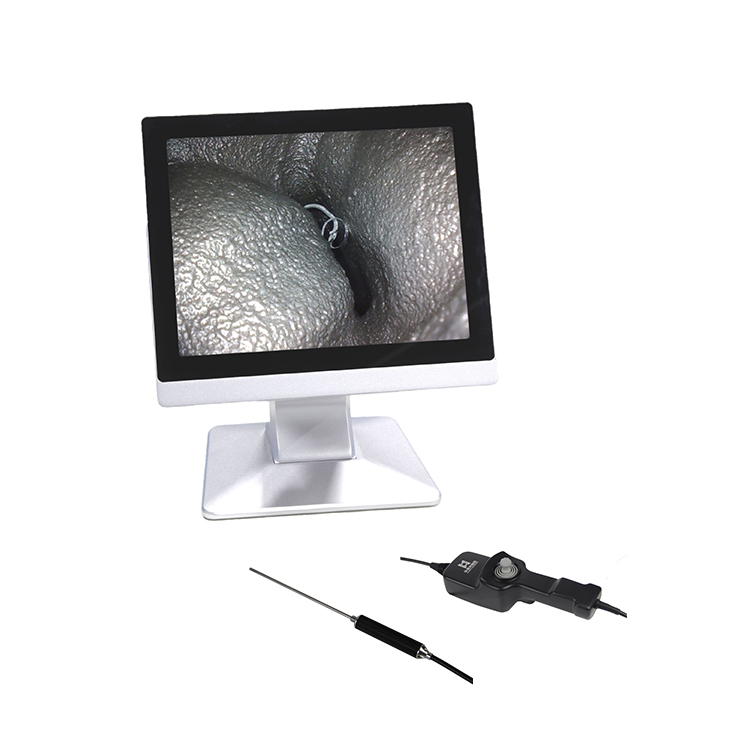
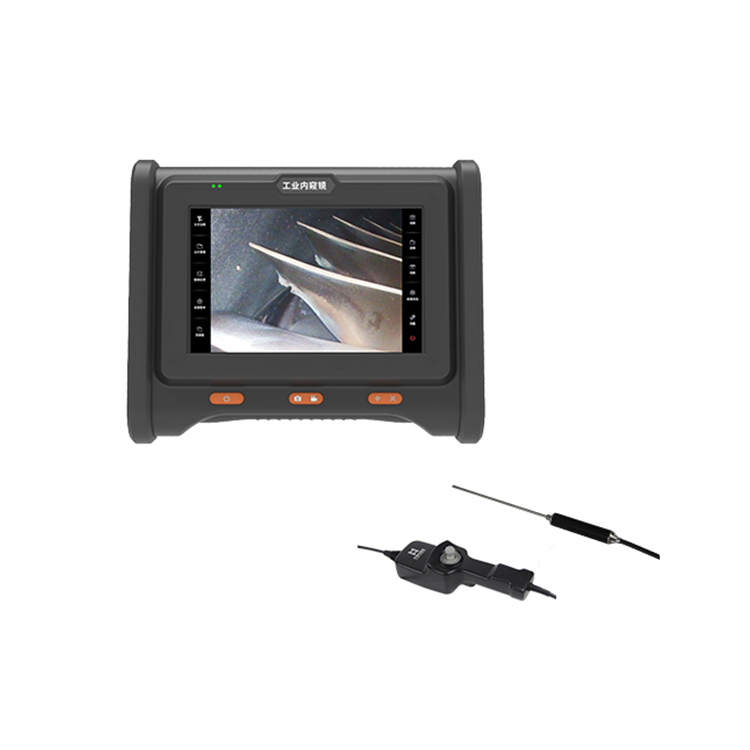
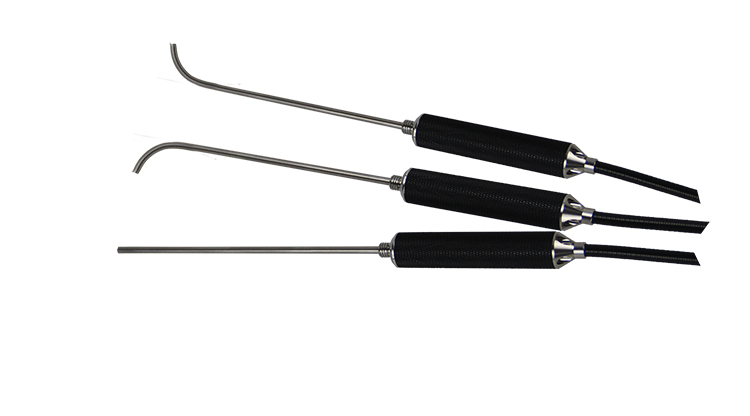
A rigid borescope, also known as a rigid inspection scope or rigid endoscope, uses a fixed, non-flexible insertion tube.
Unlike a flexible borescope, the insertion tube cannot bend or change its shape. Its rigid structure provides a fixed viewing direction and a stable optical path.
Rigid borescopes are primarily designed for straight, unobstructed inspection paths where the access opening and inspection target are aligned.
Because the insertion tube remains stable during inspection, rigid borescopes can provide consistent image quality with minimal image movement. They are well suited for simple inspection tasks involving straight holes, tubes, passages, and accessible internal cavities.
For straightforward, direct-access inspections, a rigid borescope can be a practical and cost-effective solution.
3. What Is a Flexible Borescope?
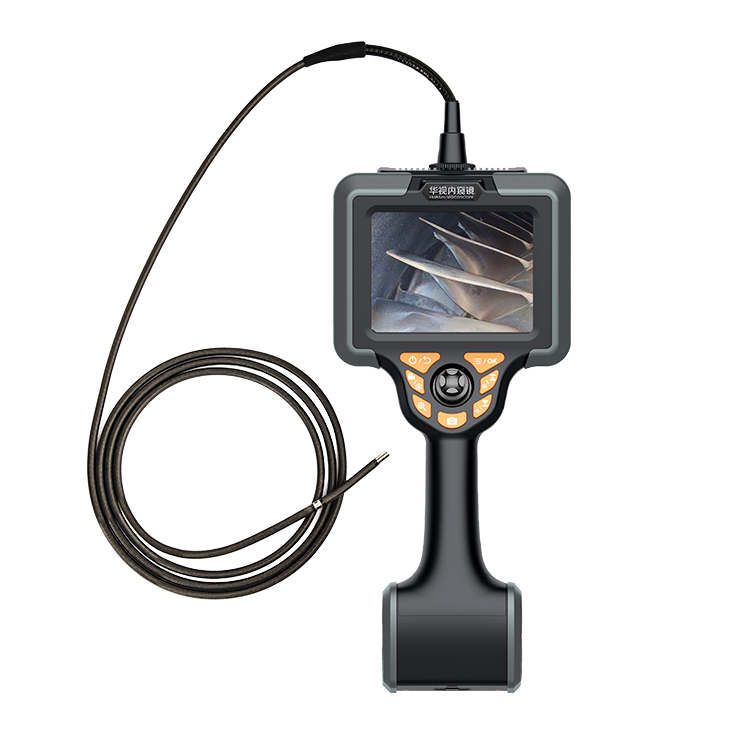
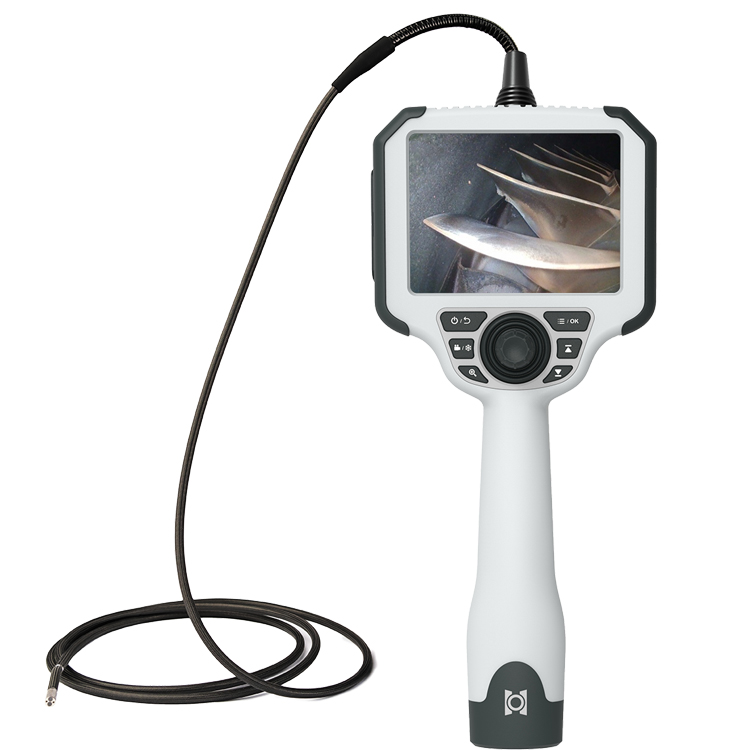
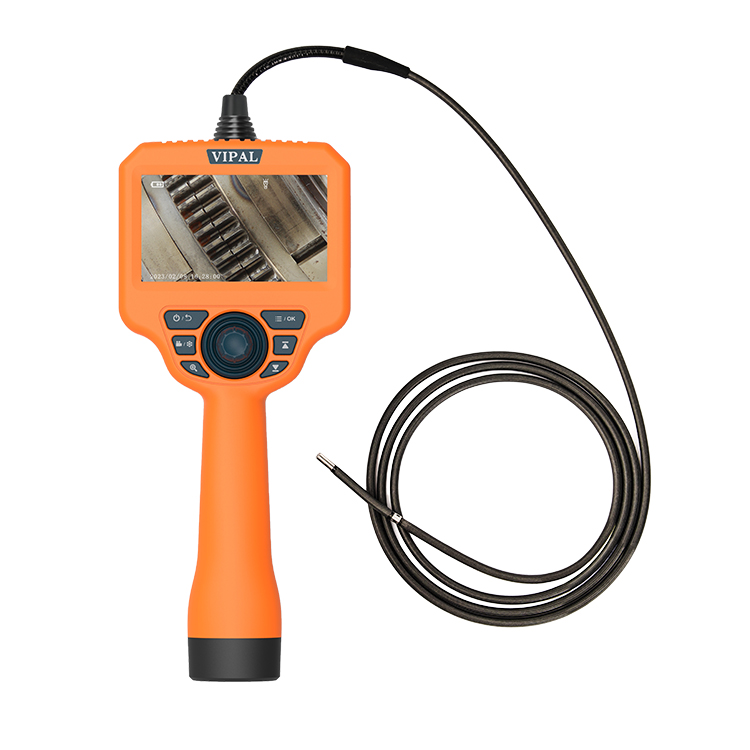
A flexible borescope, also called a flexible videoscope, uses a bendable insertion tube that can navigate curved, irregular, and multi-angle internal passages.
Many industrial flexible borescopes are equipped with manual or motorized articulation, allowing inspectors to control the direction of the camera tip and adjust the viewing angle remotely.
This flexibility allows the probe to navigate around internal obstacles, follow curved inspection paths, and reach areas that cannot be accessed with a rigid scope.
With the ability to bend, steer, and navigate through complex structures, flexible videoscopes are suitable for a wide range of industrial inspection applications and generally provide greater versatility than rigid borescopes.
4. Flexible Borescope vs. Rigid Borescope: Key Differences
| Feature | Flexible Borescope | Rigid Borescope |
|---|---|---|
| Curved Path Compatibility | Excellent; can navigate bends and curved passages | Limited; cannot bend around corners |
| Straight Path Inspection | Excellent | Excellent; highly stable for straight-line inspection |
| Complex Geometry | Highly suitable for multi-angle and irregular structures | Limited to relatively straight and accessible structures |
| Articulation / Steering | Typically available; camera direction can be controlled | Generally fixed viewing direction |
| Navigation Method | Flexible navigation and multi-angle scanning | Straight insertion and fixed-point observation |
| Typical Applications | Complex industrial inspection | Simple straight-path inspection |
| Inspection Versatility | High | More specialized |
| Typical Cost | Generally higher | Generally lower |
The key difference is simple: rigid borescopes are optimized for straight access, while flexible borescopes are designed to navigate complex inspection paths.
5. When Should You Choose a Flexible Borescope?
A flexible videoscope is generally the preferred solution for complex industrial inspections.
Consider a flexible borescope when any of the following conditions apply:
The inspection path contains bends, corners, or irregular passages that cannot be accessed in a straight line
The inspection target is deep inside the equipment and requires a long insertion distance
Internal obstacles require the probe to navigate around or avoid obstructions
Multiple surfaces, sidewalls, upper surfaces, or difficult-to-see areas need to be inspected from different viewing angles
The inspection requires high-resolution photographs, video recording, and digital inspection records
With controllable articulation and a flexible insertion tube, industrial videoscopes can reach a much wider range of inspection areas.
They are particularly useful for non-standard equipment, complex machinery, deep cavities, and internal structures containing multiple bends or access restrictions.
6. When Should You Choose a Rigid Borescope?
A rigid borescope can be a better choice when the inspection path is simple, straight, and unobstructed.
Typical applications include:
The inspection path is completely straight with no bends or obstructions
The access opening is directly aligned with the inspection target
A fixed viewing direction is sufficient
There is no need to navigate around internal obstacles
The inspection only requires straightforward visual verification
For standardized inspection applications involving straight holes, tubes, passages, and simple cavities, rigid borescopes can offer stable imaging, simple operation, and lower equipment costs.
In these situations, the additional flexibility and articulation of a flexible videoscope may not be necessary.
7. Common Industrial Applications of Flexible Borescopes
Flexible videoscopes can be used across a wide range of industries because of their ability to navigate complex internal structures.
Typical applications include:
Aerospace Inspection
Inspection of aircraft engines, turbines, combustion areas, structural cavities, and other complex internal components.
Automotive Inspection
Inspection of automotive engines, cylinders, combustion chambers, transmissions, and other precision components.
Power Generation Equipment
Inspection of industrial gearboxes, turbines, generators, and other power generation equipment.
Pipeline Inspection
Inspection of long and curved pipelines, internal walls, weld areas, and difficult-to-access passages.
Machinery and Equipment Inspection
Inspection of complex machinery, irregular cavities, narrow passages, and hidden internal structures.
For applications where the inspection target cannot be reached through a straight path, a flexible industrial videoscope can significantly improve accessibility and inspection coverage.
8. Three Questions for Fast Industrial Borescope Selection
A simple three-question approach can help determine which type of borescope is appropriate for a particular inspection task.
1. Is the inspection path completely straight?
Yes → A rigid borescope may be suitable.
No → A flexible borescope is generally preferred.
2. Does the probe need to bend around obstacles or navigate corners?
Yes → Choose a flexible borescope.
No → A rigid borescope may be sufficient if the path is straight and accessible.
3. Does the inspection require changing the camera direction or scanning multiple surfaces?
Yes → Choose a flexible videoscope with articulation or steering capability.
No → A rigid borescope may meet the inspection requirements.
This approach helps inspectors quickly narrow down the appropriate equipment based on the actual geometry of the inspection path.
9. Flexible vs. Rigid Borescope: Which One Should You Choose?
There is no absolute winner between flexible and rigid borescopes. The key difference is their structural suitability for different inspection environments.
A rigid borescope offers stable imaging, simple operation, and potentially lower cost. It is particularly effective for straight, unobstructed inspection paths where the viewing direction does not need to change.
A flexible videoscope, on the other hand, provides greater flexibility through a bendable insertion tube and articulation capability. It can navigate curved paths, avoid obstacles, and inspect multiple surfaces within complex internal structures.
For modern industrial inspection involving complex machinery, deep cavities, curved passages, and multiple inspection angles, a flexible videoscope with controllable articulation is generally the more versatile option.
Ultimately, the best industrial borescope is not necessarily the most advanced or expensive model. It is the one that matches the access path, internal geometry, inspection depth, viewing requirements, and working environment of the application.