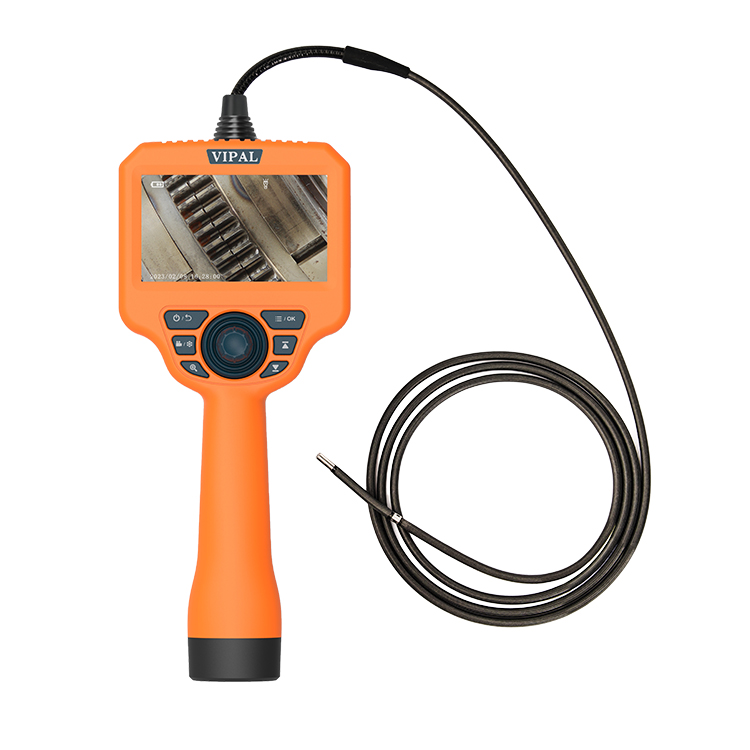

4-Way Articulation Borescope: What Is It and Why Does It Matter?
Category: News-
On: 2026-09-05
1. Introduction
When inspecting the inside of an engine, gearbox, pipeline, casting, or other complex industrial equipment, simply inserting a camera through an access opening is often not enough.
The camera may need to change direction, navigate around internal components, and look at surfaces that are not directly aligned with the access point.
This is where 4-way articulation becomes important.
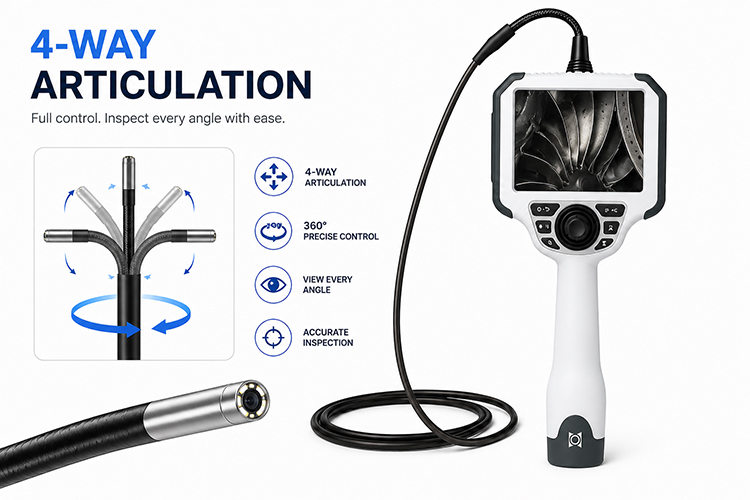
A 4-way articulation borescope allows the distal tip of a flexible probe to move in four basic directions—up, down, left, and right. This gives the operator greater control over the camera's viewing direction and makes it easier to navigate complex internal structures.
For Remote Visual Inspection (RVI), articulation is one of the key specifications to evaluate when selecting a flexible industrial videoscope.
2. What Is a 4-Way Articulation Borescope?
A 4-way articulation borescope is a flexible industrial inspection scope whose distal tip can be actively controlled in four directions.
The four basic directions are:
Up
Down
Left
Right
This provides movement across two articulation planes, giving the operator greater freedom to position the camera inside complex inspection areas.
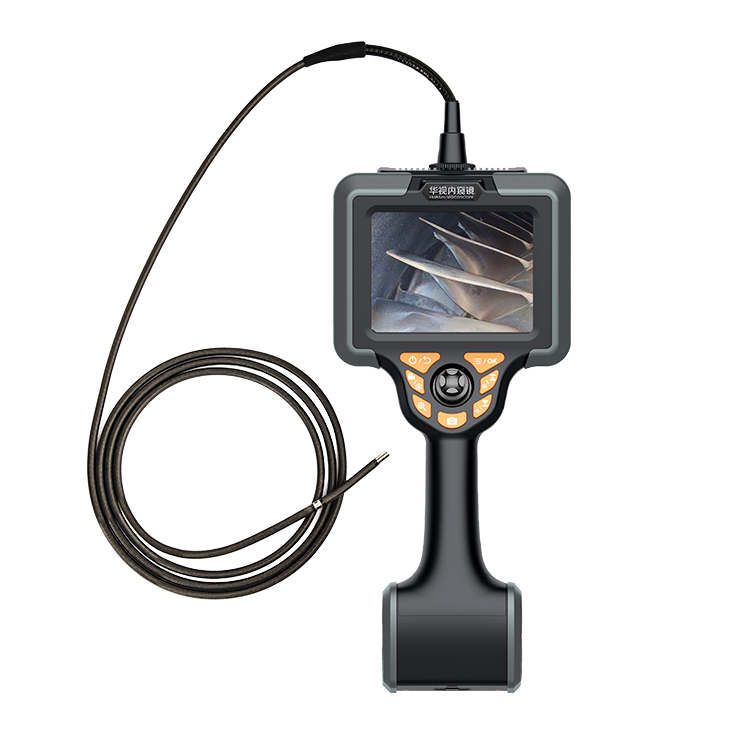
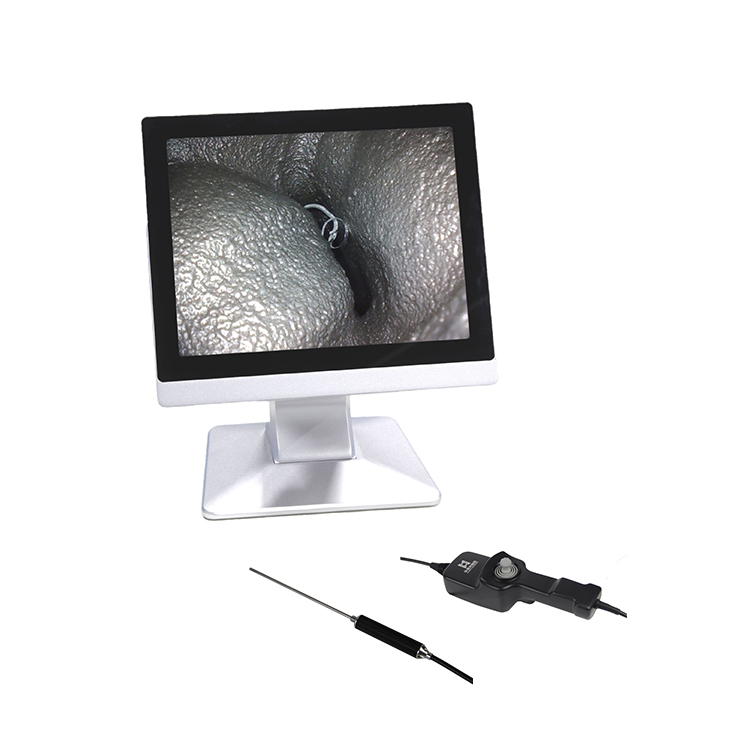
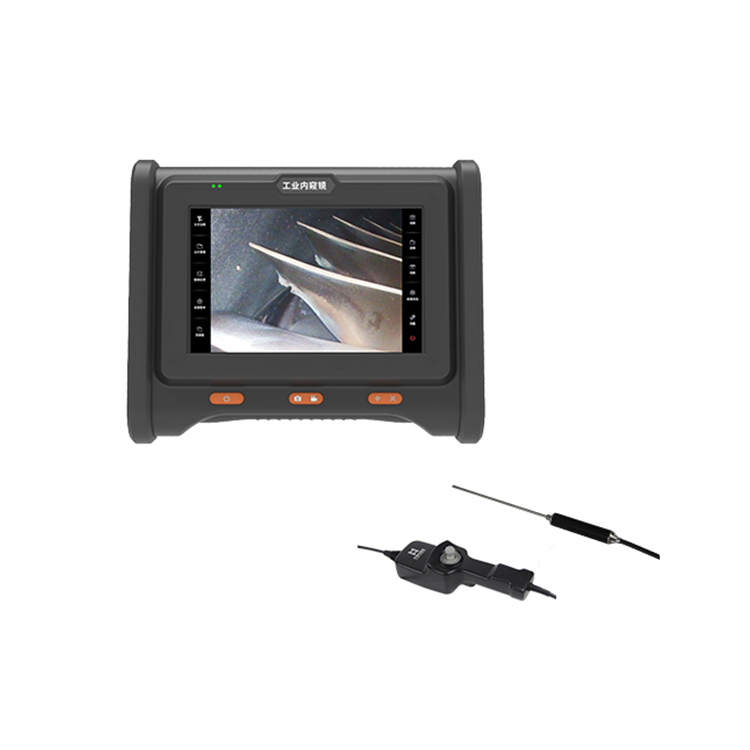
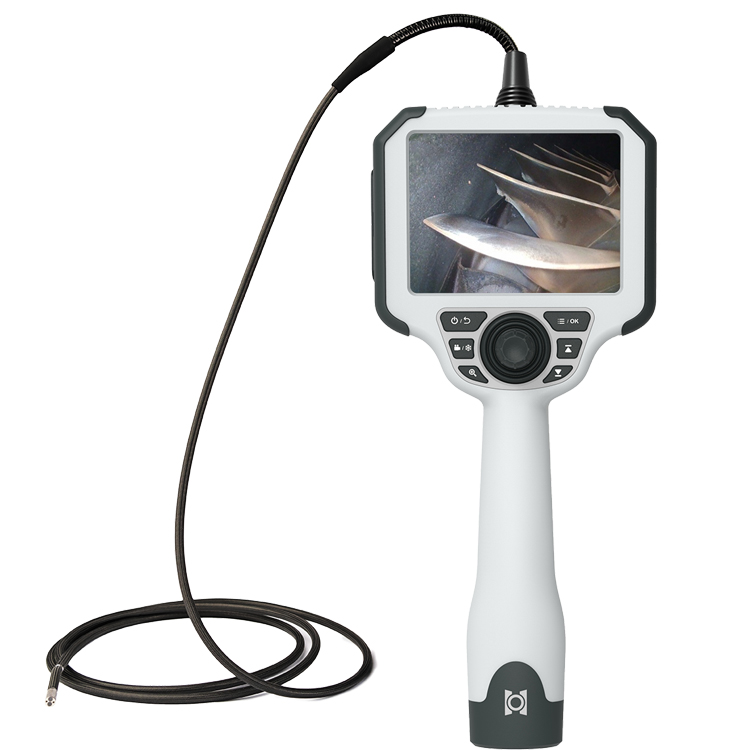
A typical 4-way articulating videoscope consists of several integrated components:
Miniature camera at the distal tip
Integrated LED illumination
Flexible insertion tube
Articulation mechanism
Joystick or steering controller
Display unit
Image and video recording system
During an inspection, the operator uses the control mechanism to change the direction of the distal tip while monitoring the live image on the display.
Instead of repeatedly rotating or repositioning the entire insertion tube, the operator can make smaller adjustments directly at the camera tip.
The actual articulation angle and controllable range vary according to the probe diameter, mechanical design, articulation mechanism, and manufacturer specifications.
3. How Does 4-Way Articulation Work?
The articulation mechanism connects the control system to the distal bending section of the probe.
Depending on the borescope design, articulation may be achieved through mechanical control wires, pulleys, joints, motors, or other steering mechanisms.
In a conventional manually articulated system, the operator moves a joystick or control lever to steer the distal tip.
The basic operating logic is intuitive:
Joystick up → distal tip bends upward
Joystick down → distal tip bends downward
Joystick left → distal tip bends left
Joystick right → distal tip bends right
This allows the operator to make real-time adjustments while watching the inspection image.
For example, when a camera encounters a gear, shaft, pipe elbow, or internal partition, the operator can adjust the distal tip to navigate around the obstacle instead of moving the entire probe.
Some advanced industrial videoscopes use motorized articulation, which can provide smoother steering and more precise tip positioning depending on the system design.
4. Why Is Articulation Important in Industrial Inspection?
The value of articulation becomes clear when the inspection target is not directly aligned with the access opening.
A fixed-view camera may only see the surface directly in front of it. If another component is located behind a shaft, around a corner, or on another side of the inspection cavity, the operator may have difficulty positioning the camera correctly.
A 4-way articulating borescope provides greater control over the camera's orientation.
Better Navigation
The operator can steer the distal tip around internal structures and follow curved inspection paths.
More Flexible Viewing
The camera can be directed toward different surfaces without constantly repositioning the entire probe.
More Precise Target Positioning
Small articulation adjustments allow the operator to position the camera closer to a specific inspection area.
Better Access to Complex Structures
Four-way articulation is particularly useful when the inspection path includes:
Multiple bends
Internal partitions
Shafts
Gears
Bearings
Narrow passages
Offset inspection targets
Articulation does not guarantee complete inspection coverage, but it can significantly improve the accessibility and controllability of a flexible borescope.
5. 4-Way Articulation vs. Non-Articulating Borescopes
The difference between an articulating and non-articulating probe becomes particularly noticeable in complex inspection environments.
| Feature | Non-Articulating Borescope | 4-Way Articulation Borescope |
|---|---|---|
| Distal tip control | Limited | Up / Down / Left / Right |
| Camera orientation | Mainly adjusted by moving the probe | Directly adjusted at the distal tip |
| Straight passages | Suitable | Suitable |
| Complex passages | More difficult | Better suited |
| Obstacle navigation | Limited | More flexible |
| Target positioning | Less precise | More precise |
| Operator control | Basic | Higher |
| Typical application | Simple visual inspection | Complex industrial inspection |
A non-articulating borescope can still be an excellent choice for simple inspection tasks.
If the target is directly visible through a straight access path, additional articulation may provide little practical benefit.
However, for complex industrial equipment, 4-way articulation can substantially improve inspection flexibility.
6. 2-Way vs. 4-Way Articulation
Industrial borescopes commonly use 2-way or 4-way articulation.
The main difference is the number of controllable directions and the resulting steering flexibility.
2-Way Articulation
A 2-way articulating probe typically bends in two opposite directions within a single plane.
For example:
Up ↕ Down
This configuration can be suitable for:
Relatively straight inspection paths
Simple internal structures
Applications with limited directional changes
Cost-sensitive inspection systems
Its simpler design can also make it an economical solution for applications that do not require full two-plane steering.
4-Way Articulation
A 4-way articulating probe provides:
Up / Down + Left / Right
This means the distal tip can be controlled across two planes.
It is better suited to:
Complex cavities
Multiple bends
Offset inspection targets
Dense internal components
Multi-directional inspection
Deep inspection paths
For applications where the operator needs to repeatedly navigate around internal obstacles and inspect surfaces from different directions, 4-way articulation generally provides greater flexibility than 2-way articulation.
7. Why Articulation Becomes More Important With Longer Probes
Probe length and articulation should be considered together.
A short probe used in a relatively straight inspection path may be easy to position even with limited articulation.
As the probe becomes longer, the inspection path may become more difficult to navigate, especially when it contains multiple bends or internal obstacles.
For example, a 10 m or 20 m long-distance borescope may need to travel through a long pipeline or large industrial structure before reaching the target.
In this situation, simply having a long probe does not guarantee effective inspection.
The camera must also be capable of being positioned at the target.
Therefore:
Long probe length provides reach; articulation provides directional control.
Both are important for deep and complex inspection applications.
The actual performance also depends on probe diameter, stiffness, flexibility, internal geometry, and the design of the articulation mechanism.
8. Industrial Applications of 4-Way Articulation Borescopes
1. Engine Inspection
Engines contain complex internal components and often provide limited inspection access.
A 4-way articulating borescope can help operators direct the camera toward different areas inside the engine, depending on the available access points and inspection procedure.
Typical inspection targets include:
Cylinder walls
Pistons
Valves
Combustion chambers
Internal surfaces
Turbine-related components
Potential findings may include:
Carbon deposits
Surface damage
Cracks
Wear
Burning or erosion
Actual inspection procedures should follow the equipment manufacturer's maintenance requirements and applicable inspection standards.
2. Gearbox Inspection
Industrial gearboxes contain gears, shafts, bearings, and other components that can obstruct the camera's line of sight.
A 4-way articulating borescope allows the operator to adjust the camera orientation and inspect different areas of the gearbox.
Potential inspection targets include:
Gear teeth
Bearings
Shafts
Housing surfaces
Lubrication areas
Inspectors may look for:
Wear
Pitting
Corrosion
Surface damage
Abnormal lubrication conditions
3. Casting Inspection
Castings can contain complex cavities, narrow passages, and internal structures that are difficult to inspect from a single viewing direction.
A flexible 4-way articulating borescope can navigate through suitable access openings and allow the operator to inspect internal surfaces from different directions.
Potential applications include inspection for:
Visible cracks
Surface defects
Casting residues
Foreign material
Porosity-related surface indications
Machining defects
Borescope inspection is primarily a visual inspection method. Subsurface or internal defects that are not visible from the inspected surface may require complementary NDT methods such as ultrasonic testing or radiographic testing.
4. Weld Inspection
Pipe welds, internal welds, and complex welded structures can be difficult to view when the camera cannot be aligned directly with the weld.
A 4-way articulating probe can help position the camera for closer visual examination.
Potential visual inspection targets include:
Weld bead surfaces
Weld roots
Surface cracks
Undercut
Visible porosity
Surface irregularities
For defects that require volumetric or subsurface evaluation, other NDT methods should be used according to the applicable inspection procedure.
5. Aerospace Inspection
Aerospace components often contain small openings, complex internal structures, and demanding inspection requirements.
Flexible articulating videoscopes can be used for remote visual inspection of suitable components where the equipment design and approved inspection procedures permit.
Typical applications can include:
Engine components
Turbine areas
Airframe structures
Fuel system components
Hydraulic passages
For aerospace maintenance, inspection procedures must always follow the applicable manufacturer documentation and regulatory requirements.
6. General Machinery Maintenance
Industrial machinery often contains enclosed cavities that are difficult or expensive to access through conventional disassembly.
A flexible articulating borescope can provide visual access through suitable inspection openings and help maintenance personnel assess internal conditions.
Potential applications include:
Pumps
Compressors
Motors
Mechanical equipment
Production machinery
Enclosed assemblies
Depending on the equipment design, borescope inspection may reduce the amount of disassembly required for an initial visual assessment.
9. What Makes a Good 4-Way Articulation Borescope?
Articulation is an important feature, but it should not be evaluated independently.
When selecting a 4-way articulating videoscope, consider the complete system.
1. Probe Diameter
The probe must fit through the smallest inspection opening.
Common industrial configurations may include small-diameter probes as well as larger general-purpose probes.
The smaller the access opening, the more important the probe diameter becomes.
2. Actual Articulation Range
Do not evaluate a borescope simply because the product description says “4-way articulation.”
Check the actual specifications, including:
Maximum articulation angle
Articulation range
Bending radius
Effective steering range
Tip response
A greater usable articulation range can provide more flexibility, but the actual inspection requirement should determine what is necessary.
3. Camera Resolution
Camera resolution affects the amount of image detail available to the operator.
Depending on the probe diameter and imaging system, industrial borescopes may use different resolutions.
However, resolution should be evaluated together with:
Image sensor
Lens quality
Illumination
Image processing
Working distance
Higher resolution does not automatically mean better overall image quality.
4. Illumination
Internal machinery and pipelines are often completely dark.
A suitable illumination system is therefore essential for useful inspection images.
Look for:
Sufficient brightness
Even illumination
Adjustable intensity
Controlled reflections
Good performance in dark cavities
5. Probe Length
The probe must be long enough to reach the inspection target without introducing unnecessary excess length.
Typical configurations may include:
1 m → 2 m → 3 m → 5 m → 10 m → 20 m
Special configurations may also be available depending on the manufacturer.
Probe length should be determined by the actual inspection path rather than the overall size of the equipment.
6. Steering Control
A good articulation control system should provide:
Smooth movement
Predictable response
Precise positioning
Comfortable operation
Good joystick feedback
For long inspection tasks, ergonomic controls can also reduce operator fatigue.
Some systems may provide motorized articulation, which can offer additional control features depending on the design.
7. Viewing Direction
The required viewing direction should also be considered.
Depending on the application, you may need:
Forward View
Side View
Dual View
Switchable Viewing Direction
For example, a side-view configuration can be useful when the target surface is located perpendicular to the insertion path.
10. 4-Way Articulation vs. 360° Articulation
These terms are sometimes used interchangeably in marketing, but they should not automatically be treated as identical specifications.
4-Way Articulation
4-way articulation describes the basic controllable directions:
Up
Down
Left
Right
It is a practical way of describing two-plane distal-tip steering.
360° Articulation
The term 360° articulation is often used to describe a broad or near-all-direction steering capability.
However, the exact meaning can vary between manufacturers.
A product advertised as having “360° articulation” may refer to the overall directional coverage of the distal tip rather than a single standardized articulation-angle specification.
Therefore, when comparing products, do not rely on the marketing term alone.
Check the actual:
Articulation angle
Directional range
Bending radius
Steering mechanism
Tip movement
Demonstration performance
Always compare the actual specifications rather than the terminology.
11. Does 4-Way Articulation Make Inspection Easier?
For complex inspection tasks, yes.
A non-articulating probe may require the operator to repeatedly:
Insert the probe
Rotate the insertion tube
Retract the probe
Reposition it
Insert it again
Repeat the process
A 4-way articulating videoscope allows the operator to make many directional adjustments directly at the distal tip.
A typical workflow becomes:
Insert → View → Articulate → Navigate → Position → Inspect → Record
This can reduce unnecessary probe repositioning and make complex inspection work more efficient.
However, articulation does not eliminate the need for operator skill. Successful inspection still depends on understanding the equipment structure, access path, probe characteristics, and inspection procedure.
12. Is 4-Way Articulation Always Necessary?
No.
A 4-way articulation borescope is not automatically the best choice for every inspection.
A Basic Probe May Be Enough When:
The inspection path is straight
The target is directly visible
There are few internal obstacles
The inspection is shallow
Only basic visual confirmation is required
2-Way Articulation May Be Enough When:
The inspection requires movement in one plane
The internal structure is relatively simple
The inspection path contains limited bends
Cost is an important consideration
4-Way Articulation Is More Useful When:
The target is offset from the access point
The path contains multiple bends
Internal components obstruct the camera
Multiple surfaces need to be examined
Deep inspection is required
Precise camera positioning is important
The best configuration is therefore determined by the inspection geometry, not simply by the number of articulation directions.
13. How to Choose the Right 4-Way Articulating Borescope
Before purchasing a 4-way articulation videoscope, answer these seven questions:
1. What is the smallest access opening?
This determines the maximum probe diameter.
2. How deep is the inspection target?
This determines the required probe length.
3. How complex is the inspection path?
The number and severity of bends help determine the required articulation capability.
4. What defects are you looking for?
This affects the required camera resolution, optics, illumination, and viewing distance.
5. Do you need measurement?
If dimensional measurement is required, evaluate calibration, measurement algorithms, optical performance, and stated measurement accuracy.
6. What viewing direction do you need?
Determine whether the application requires forward view, side view, or dual view.
7. What is the operating environment?
Consider:
Water
Oil
Dust
High temperature
Chemicals
Confined spaces
Other environmental conditions
The borescope's protection and temperature specifications should match the actual operating environment.
14. WorldNDT 4-Way Articulating Videoscope Solutions
WorldNDT provides industrial videoscope configurations designed for different Remote Visual Inspection applications.
Depending on the inspection requirements, the system can be configured around key parameters such as:
Probe diameter
Probe length
4-way articulation
Articulation range
Camera resolution
Viewing direction
Illumination
Image and video recording
Measurement capability
Environmental protection
For complex inspection applications, selecting the complete configuration is more important than choosing articulation alone.
By providing information such as access opening, inspection depth, internal geometry, target type, and operating environment, users can identify a more suitable borescope configuration for their application.
15. Frequently Asked Questions
What is a 4-way articulation borescope?
A 4-way articulation borescope is a flexible industrial videoscope whose distal tip can be controlled in four basic directions: up, down, left, and right.
Is a 4-way borescope better than a 2-way borescope?
For complex inspection paths, 4-way articulation generally provides greater steering flexibility. For simple or mostly straight inspection paths, 2-way articulation may be sufficient and more economical.
What is 360° articulation?
360° articulation is commonly used as a marketing term for broad directional steering capability. Because the exact meaning varies between products, buyers should check the actual articulation specifications rather than relying on the term alone.
Which industries use 4-way articulating borescopes?
Common applications include automotive inspection, aerospace inspection, power generation, wind turbine inspection, gearbox inspection, casting inspection, pipeline inspection, machinery maintenance, and marine equipment inspection.
Does articulation affect probe length?
Probe length and articulation should be considered together. Longer probes and more complex inspection paths can place greater demands on steering performance, flexibility, stiffness, and tip control.
16. Conclusion
A 4-way articulation borescope provides significantly greater directional control than a basic non-articulating probe and offers more flexibility than a 2-way system for complex inspection paths.
By controlling the distal tip in four directions—up, down, left, and right—operators can navigate around internal obstacles, adjust the camera orientation, and position the viewing tip more precisely.
This makes 4-way articulation particularly useful for applications such as:
Engine inspection
Gearbox inspection
Pipeline inspection
Casting inspection
Weld inspection
Aerospace inspection
Power generation equipment
General industrial machinery
However, articulation is only one part of a complete industrial borescope.
The right system should combine:
Probe Diameter + Probe Length + Articulation + Camera Resolution + Optics + Illumination + Viewing Direction + Environmental Protection
When selecting a 4-way articulating videoscope, focus on the actual inspection geometry and target requirements rather than simply choosing the product with the largest specification numbers.
For simple straight inspections, a basic or 2-way system may be sufficient. For complex, deep, multi-directional inspection paths, 4-way articulation can provide a substantial practical advantage in navigation, positioning, and inspection efficiency.
Need help choosing a 4-way articulating videoscope? Provide your access opening, inspection depth, internal path, and application requirements, and WorldNDT can help identify the appropriate configuration.