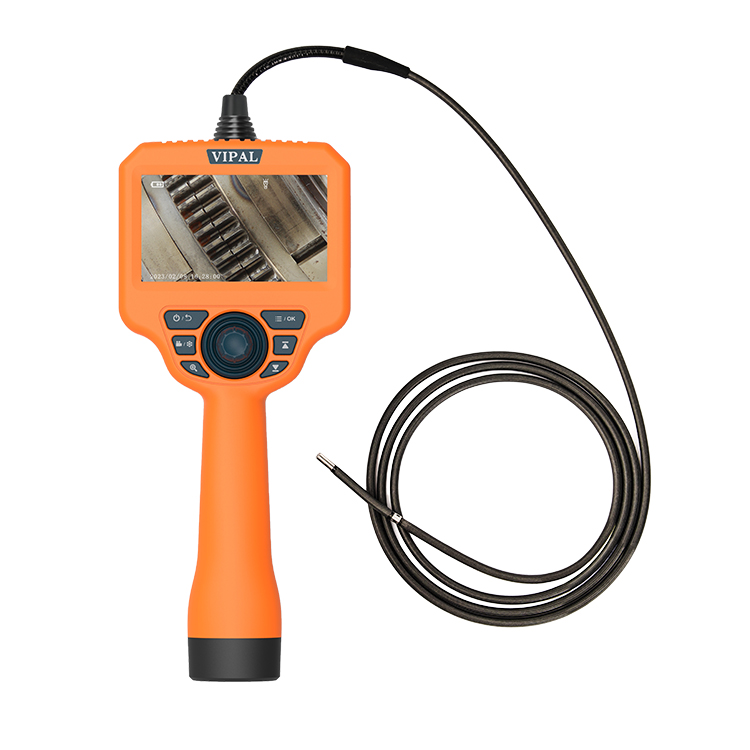

360° Articulating Borescope: Advantages, Applications and Selection Guide
Category: News-
On: 2026-09-07
1. Introduction
Industrial Remote Visual Inspection (RVI) often requires inspectors to examine areas that are difficult or impossible to access directly. Equipment may have only a small inspection opening, while the target area can be several meters away. Gears, shafts, pipes, turbine blades, brackets, welds, and other internal structures can further obstruct the inspection path.
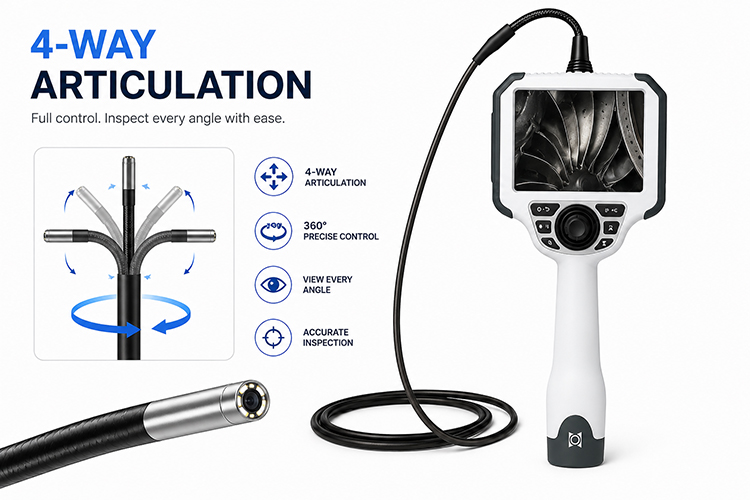
A conventional fixed-view borescope may have limited ability to change the viewing direction once the probe has entered the equipment. An articulating borescope provides active control of the distal tip, allowing inspectors to steer the camera toward different areas inside complex cavities.
The main value of 360° articulation is not simply the number "360°." It is the ability to combine probe insertion, directional control, and real-time visual feedback to reach and position the camera more effectively in complex inspection environments.
This guide explains how 360° articulating borescopes work, their advantages, major industrial applications, and the key specifications to consider before purchasing.
2. What Is a 360° Articulating Borescope?
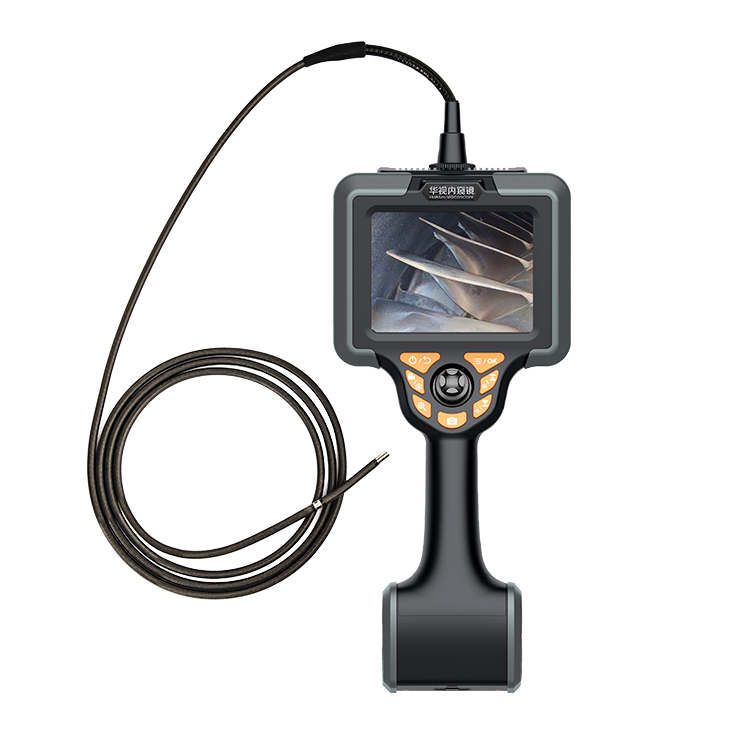
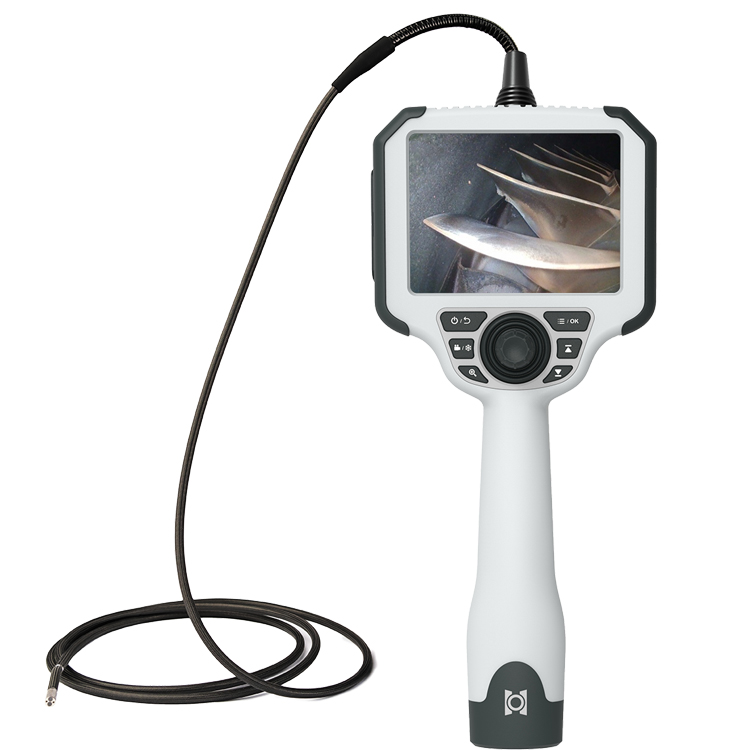
A 360° articulating borescope is a flexible industrial inspection system that allows the distal end of the probe to be actively steered in multiple directions.
Depending on the design, the operator may control the distal tip using a mechanical joystick, steering mechanism, or motorized articulation system. This makes it possible to adjust the camera position after the probe has entered a confined space.
The articulation system can help the operator:
Navigate around internal obstacles
Change the viewing direction
Position the camera near the inspection target
Examine multiple areas from a single access point
Follow curved or non-linear inspection paths
However, the term "360°" is not a universal technical specification. Different manufacturers may use the term differently.
When comparing products, always check the actual specifications, including:
Articulation angle
Articulation directions
Steering mechanism
Minimum bending radius
Tip response
Articulation control
Probe diameter and length
The actual technical specifications are more important than the marketing term "360°."
3. How Does a 360° Articulating Borescope Work?
An articulating borescope uses a flexible insertion tube combined with an internal steering mechanism.
Depending on the product design, the articulation mechanism may use mechanical control wires, a joystick-controlled steering system, or motorized articulation.
A typical inspection process is:
Insert the probe → Steer the distal tip → Position the camera → Inspect the target → Record images or video
The operator first inserts the probe through an existing inspection opening. The live image from the camera provides real-time visual feedback while the operator adjusts the steering control.
By combining probe movement with articulation, the camera can be positioned toward targets that are not directly aligned with the entry point.
This is particularly useful when the inspection path contains bends, internal components, or other obstructions.
4. 360° Articulation vs. Fixed-View and 4-Way Articulation
4.1 Articulating Borescope vs. Fixed-View Borescope
A fixed-view or non-articulating borescope is generally suitable when the inspection path is relatively straight and the target is directly ahead of the camera.
For example, it may be sufficient for:
Straight holes
Simple cavities
Short inspection paths
Areas with minimal internal obstruction
Complex industrial equipment can present a different challenge.
The target may be located:
Behind a gear
Around a shaft
Beneath a turbine blade
Inside a curved pipe
Behind a structural bracket
Along a side wall
Around an internal corner
An articulating borescope gives the operator greater directional control, making it easier to position the camera in these environments.
4.2 4-Way Articulation vs. 360° Articulation
These terms can sometimes cause confusion.
A 4-way articulating borescope generally refers to a probe whose distal tip can be steered in four basic directions:
Up / Down / Left / Right
A product described as having 360° articulation generally indicates broader directional steering capability around the distal tip.
However, these terms should not be treated as universally standardized industry definitions.
For example, a manufacturer may describe a probe as "360° articulating" while the actual technical specification defines a particular articulation range in two planes.
Therefore, when comparing products, do not rely only on the product name.
Instead, compare:
| Specification | What to Check |
|---|---|
| Articulation direction | 2-way, 4-way, or other configuration |
| Articulation angle | Actual maximum tip deflection |
| Steering method | Mechanical or motorized |
| Tip response | How precisely the tip follows control input |
| Bending radius | Minimum safe bending radius |
| Probe diameter | Access capability |
| Probe length | Inspection reach |
Important Note About "360°"
360° articulation does not necessarily mean that the camera physically rotates continuously through 360°.
In industrial borescopes, the term generally describes multi-directional steering capability. The actual movement depends on the mechanical or motorized design.
Always refer to the manufacturer's technical specifications when evaluating articulation performance.
5. Key Advantages of a 360° Articulating Borescope
5.1 Better Access to Complex Inspection Areas
The primary advantage is improved accessibility.
Instead of relying only on the direction of probe insertion, the operator can steer the distal tip toward the inspection target.
This is particularly useful for complex internal structures where the access opening and target are not aligned.
5.2 Flexible Navigation Around Obstacles
Industrial equipment frequently contains gears, shafts, pipes, brackets, blades, and other components.
A flexible articulating probe can be guided around these obstacles, depending on the available space and probe specifications.
This can make complex internal navigation more practical than using a fixed-view inspection system.
5.3 Improved Inspection Coverage
When several targets are accessible through a single inspection opening, articulation can allow the operator to change the viewing direction without completely removing and repositioning the probe.
This can improve inspection efficiency and help cover multiple areas from the same access point.
Actual inspection coverage still depends on the probe length, diameter, articulation range, viewing direction, optical characteristics, and internal geometry.
5.4 More Precise Camera Positioning
Articulation allows the operator to make fine adjustments to the camera position.
This is useful when inspecting:
Small cracks
Surface wear
Corrosion
Pitting
Foreign objects
Surface contamination
Weld areas
Good camera positioning can also improve the consistency of visual inspection and image documentation.
5.5 Potentially Less Disassembly
In suitable applications, an articulating borescope can access internal areas through existing inspection ports or other available openings.
This may reduce the amount of equipment disassembly required for visual inspection.
However, whether disassembly can be avoided depends entirely on the equipment design, access points, inspection procedure, and safety requirements.
6. Major Applications of 360° Articulating Borescopes
6.1 Gearbox Inspection
Gearbox inspection is one of the most important applications for articulating borescopes.
A gearbox may contain gears, bearings, shafts, housings, lubrication systems, and other components that create complex inspection paths.
An articulating probe can help inspectors position the camera around internal components to examine:
Gear tooth wear
Surface damage
Cracks
Pitting
Bearing condition
Foreign objects
Lubrication-related contamination
Housing damage
For large gearboxes, a combination of long probe length and articulation can be particularly useful.
6.2 Automotive and Aircraft Engine Inspection
Engine components are often located inside confined spaces that are difficult to access directly.
A flexible articulating borescope can be used for visual inspection of areas such as:
Cylinders
Combustion chambers
Pistons
Valves
Turbine components
Internal engine surfaces
In aviation applications, inspections must follow the applicable maintenance procedures, equipment requirements, and manufacturer's technical documentation.
6.3 Turbine Inspection
Gas turbines and other rotating machinery contain complex internal structures, including blades, blade roots, nozzles, housings, and other components.
An articulating videoscope can help inspectors position the camera toward difficult-to-reach areas and examine potential signs of:
Cracking
Erosion
Corrosion
Wear
Foreign object damage
Surface deterioration
High-quality imaging and appropriate illumination are especially important when inspecting small surface indications.
6.4 Wind Turbine Gearbox Inspection
Wind turbine gearboxes are large systems with multiple gears, bearings, shafts, and internal components.
Inspection paths may be long and difficult to navigate.
A suitable long-probe articulating borescope can help inspectors reach internal areas through available inspection openings and examine components from different viewing directions.
Probe length, diameter, articulation range, and probe flexibility should be evaluated together for this application.
6.5 Pipe Inspection
Articulating borescopes can also be used for certain pipe inspection applications, especially where the inspection path contains bends or internal structures.
Typical inspection targets include:
Internal corrosion
Deposits
Blockages
Foreign objects
Surface damage
Internal weld areas
The probe must be matched to the pipe's internal diameter, access geometry, inspection distance, and environmental conditions.
For long pipelines, specialized pipe inspection systems may be more appropriate depending on the inspection requirements.
6.6 Precision Casting Inspection
Complex castings can contain enclosed cavities and irregular internal passages.
A small-diameter flexible probe can enter these areas through relatively small access openings and provide visual access to internal surfaces.
Potential inspection targets include:
Surface cracks
Porosity visible from the surface
Inclusions visible from the surface
Machining-related defects
Surface contamination
Internal cavity condition
Borescope inspection is a visual inspection method and may need to be combined with other NDT techniques when internal or subsurface defects cannot be visually accessed.
6.7 Weld Inspection
Articulating borescopes can be useful for inspecting weld areas inside pipes, vessels, and other structures where direct visual access is limited.
They may help inspect:
Weld roots
Internal weld surfaces
Weld-related surface cracks
Visible porosity
Surface contamination
Visible incomplete fusion or penetration indications
However, a borescope provides visual inspection rather than full volumetric weld inspection.
Depending on the application and applicable standards, UT, RT, PT, or MT may be required to identify defects that cannot be detected visually.
7. Key Specifications When Choosing an Articulating Borescope
7.1 Probe Diameter
Probe diameter determines whether the system can enter the available inspection opening.
Common industrial configurations range from ultra-small probes to larger probes designed for heavy industrial equipment.
A smaller diameter is not automatically better.
Very small probes may involve trade-offs in:
Image quality
Lighting
Mechanical strength
Probe length
Articulation performance
Durability
The best diameter is the smallest practical size that provides the required inspection performance.
7.2 Probe Length
Probe length determines how far the camera can reach into the equipment.
Typical configurations may include:
1 m
2 m
3 m
5 m
10 m
20 m
For large machinery or long inspection paths, longer probes may be necessary.
However, choosing an unnecessarily long probe can make handling and positioning more difficult.
A useful principle is:
Choose the shortest probe that can reliably reach the entire inspection area.
7.3 Articulation Performance
Do not evaluate an articulating borescope only by its "360°" label.
Check:
Maximum articulation angle
Number of articulation directions
Steering precision
Tip response
Positioning repeatability
Minimum bending radius
Steering mechanism
These specifications have a direct impact on how effectively the probe can navigate complex inspection paths.
7.4 Mechanical vs. Motorized Articulation
Mechanical Articulation
Mechanical steering typically uses a direct manual control mechanism.
Advantages may include:
Direct operator feedback
Simple operation
Compact system design
Easy control
Practicality for routine inspections
Motorized Articulation
Motorized systems use powered mechanisms to control the distal tip.
Depending on the system design, potential advantages include:
Controlled movement
More consistent positioning
Reduced manual effort
Advanced control functions
For professional inspection applications, the choice should depend on the required positioning accuracy, operating environment, inspection frequency, and overall system design.
7.5 Camera Resolution and Image Quality
Articulation alone does not determine inspection quality.
The camera sensor, optics, illumination, image processing, display, and working distance all contribute to the final image.
When evaluating an industrial videoscope, consider:
Camera resolution
Sensor performance
Optical quality
Image processing
Display resolution
Low-light performance
Image capture capability
Video recording
A highly articulating probe with poor imaging performance may still be unsuitable for detecting small surface indications.
7.6 Illumination
Many industrial inspection environments are dark or completely enclosed.
The illumination system must provide sufficient light for the camera to clearly capture the inspection target.
Good illumination is especially important for identifying:
Fine cracks
Surface wear
Corrosion
Pitting
Foreign objects
Weld indications
Lighting performance should be evaluated together with probe diameter and optical design.
7.7 Viewing Direction
The viewing direction should match the inspection target.
Forward View
A forward-view camera looks toward the direction of probe insertion and is suitable for many general inspection applications.
Side View
A side-view camera looks toward the side of the probe and can be useful for inspecting pipe walls, circumferential welds, and cylindrical surfaces.
Dual View
A dual-view system can combine forward and side viewing, reducing the need to change equipment when inspection requirements vary.
7.8 Environmental Protection
Industrial inspection may involve oil, water, dust, high humidity, or chemical contamination.
Before purchasing, check the system's:
IP rating
Operating temperature
Probe temperature rating
Water resistance
Oil resistance
Dust protection
Chemical compatibility
For specialized environments such as high-temperature or hazardous areas, additional equipment requirements and certifications may apply.
8. When Do You Need a 360° Articulating Borescope?
An articulating borescope is particularly useful when one or more of the following conditions apply:
The inspection target cannot be viewed directly from the access opening.
The inspection path contains bends or internal obstacles.
One access point needs to cover multiple inspection areas.
The camera needs frequent directional adjustment.
Internal structures create complex inspection paths.
Equipment disassembly would be costly or time-consuming, where inspection procedures permit access through existing openings.
For a simple, straight, unobstructed inspection path, a fixed-view or basic borescope may provide sufficient performance.
The right choice depends on the actual inspection geometry rather than the maximum articulation specification alone.
9. Step-by-Step Articulating Borescope Selection Guide
Before purchasing an articulating videoscope, follow these steps:
Step 1: Measure the Access Opening
Determine the smallest available inspection opening.
This defines the maximum probe diameter that can be used.
Step 2: Determine the Inspection Depth
Measure the actual path from the access point to the farthest inspection target.
Select an appropriate probe length based on the real inspection path.
Step 3: Evaluate Path Complexity
Determine whether the path is:
Straight
Curved
Multi-directional
Obstructed
Deep and difficult to navigate
This helps determine the required articulation capability.
Step 4: Define the Inspection Target
Identify what you need to detect:
Cracks
Wear
Corrosion
Pitting
Foreign objects
Weld conditions
Surface contamination
Then select appropriate imaging and illumination performance.
Step 5: Select the Viewing Direction
Choose between:
Forward View
Side View
Dual View
based on the inspection geometry.
Step 6: Determine Whether Measurement Is Required
If the inspection requires dimensional evaluation, select a videoscope with an appropriate measurement function.
Step 7: Check Environmental Conditions
Confirm:
Temperature
Humidity
Water exposure
Oil exposure
Dust
Chemical exposure
The borescope should be rated for the intended environment.
Step 8: Evaluate Usability and Maintenance
For frequent industrial inspections, also consider:
Probe durability
Replaceable probes
Control ergonomics
Display visibility
Battery life
Data storage
Accessories
Serviceability
10. WorldNDT Articulating Borescope Solutions
WorldNDT provides industrial Remote Visual Inspection solutions for applications requiring flexible probe navigation and directional control.
Depending on the inspection requirements, an articulating videoscope can be configured around key parameters such as:
Probe diameter
Probe length
Articulation system
Articulation range
Image resolution
Viewing direction
Illumination
Measurement capability
Protective accessories
These configurations can be adapted to applications including:
Gearbox inspection
Engine inspection
Turbine inspection
Wind turbine inspection
Pipe inspection
Casting inspection
Weld inspection
General machinery inspection
For complex inspection environments, the goal is not simply to maximize articulation. The probe diameter, length, articulation, image quality, illumination, and viewing direction should work together as a complete inspection system.
11. Frequently Asked Questions
Q1: What is a 360° articulating borescope?
A 360° articulating borescope is a flexible industrial videoscope that allows the operator to steer the distal end of the probe in multiple directions, helping position the camera in complex and hard-to-reach inspection areas.
Q2: Is a 360° borescope always better than a 4-way articulating borescope?
Not necessarily.
"360°" and "4-way" are not sufficient by themselves to determine performance. Compare the actual articulation angle, steering mechanism, control precision, bending radius, probe diameter, and probe length.
Q3: Is an articulating borescope suitable for gearbox inspection?
Yes. Articulation can be particularly useful for gearbox inspection because gears, shafts, bearings, and housings can create complex inspection paths.
The appropriate probe length, diameter, articulation range, and image quality should be selected according to the gearbox design.
Q4: Can an articulating borescope be used for pipe inspection?
Yes, when the probe dimensions, articulation capability, viewing direction, and environmental protection are compatible with the pipe.
For very long pipelines or specialized pipe inspection requirements, a dedicated pipe inspection system may be more appropriate.
Q5: Does 360° articulation mean the camera continuously rotates 360°?
Not necessarily.
The term generally refers to multi-directional steering capability rather than continuous physical rotation of the camera.
The actual movement should be confirmed from the manufacturer's technical specifications.
Q6: Is 4-way articulation the same as 360° articulation?
Not necessarily.
4-way articulation generally describes directional control in four basic directions, while 360° articulation is commonly used to describe broader directional steering capability. Because terminology varies between manufacturers, actual articulation specifications should always be compared.
Q7: Does a longer probe provide better inspection performance?
Not always.
A longer probe provides greater reach, but it may also affect handling and positioning. The ideal probe should be long enough to reach the complete inspection area while remaining practical to operate.
12. Conclusion
The main value of a 360° articulating borescope is its ability to provide flexible directional control in complex inspection environments.
By combining a flexible probe with active articulation, inspectors can more effectively navigate around internal structures and position the camera toward difficult-to-reach inspection targets.
This makes articulating videoscopes particularly useful for applications such as gearbox inspection, engine inspection, turbine inspection, wind turbine inspection, pipe inspection, casting inspection, and weld inspection.
However, articulation should not be evaluated in isolation.
A professional industrial borescope should be selected by considering the complete system, including probe diameter, probe length, articulation range, steering mechanism, image quality, illumination, viewing direction, environmental protection, and measurement requirements.
The best solution is not necessarily the borescope with the largest advertised articulation angle. It is the system that provides the right combination of reach, directional control, image quality, and reliability for the actual inspection task.