
Side-View Borescope: Applications and Advantages
Category: News-
On: 2026-09-09
In industrial visual inspection, most standard industrial borescopes use a forward-view optical configuration. The camera looks toward the front of the probe, making it suitable for inspecting surfaces and components directly in front of the camera.
However, many important inspection targets are located on the internal walls, side surfaces, circumferential surfaces, and other areas around the inspection path.
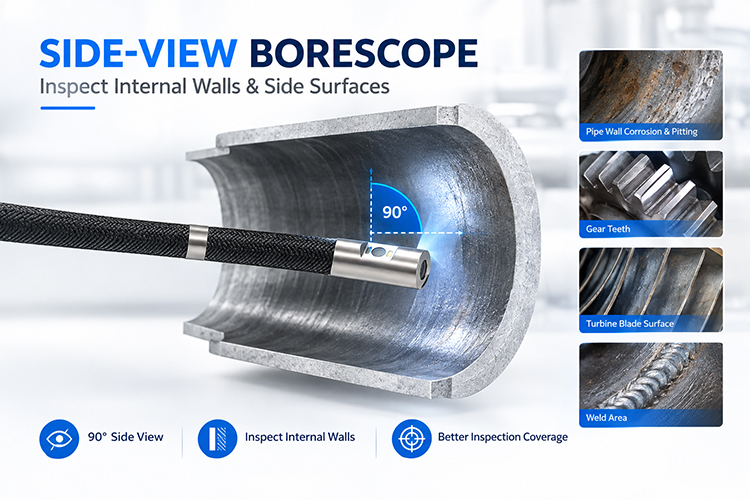
Examples include pipe walls, cylinder walls, turbine blades, gear teeth, internal bores, and weld areas.
With a conventional forward-view borescope, these surfaces may be difficult to observe directly. A side-view borescope is designed to change the viewing direction so inspectors can examine surfaces located to the side of the probe.
A typical 90-degree side-view configuration can be particularly useful for internal surface inspection, allowing inspectors to examine areas that are difficult to observe with a forward-facing camera.
1. What Is a Side-View Borescope?
A side-view borescope is an industrial inspection system designed to view surfaces located beside the probe rather than only directly in front of it.
In a typical configuration, the viewing direction is approximately 90° relative to the insertion axis.
For example:
Forward View: approximately 0° viewing direction
Side View: approximately 90° viewing direction
The exact optical design varies by manufacturer. Some systems use a dedicated side-view camera or optical arrangement, while others may use interchangeable or switchable viewing configurations.
The main advantage is straightforward:
The probe can continue moving through the inspection path while the camera observes the surrounding internal surface.
This makes side-view borescopes particularly useful for tubular structures, internal walls, bores, and components where the inspection target is positioned beside the probe.
2. How Does a Side-View Borescope Work?
A conventional forward-view borescope points the camera toward the end of the probe.
A side-view borescope changes the optical path so that the camera observes the area approximately perpendicular to the probe axis.
This allows the inspector to examine surfaces such as:
Pipe walls
Cylinder walls
Internal bores
Gear teeth
Turbine blade surfaces
Weld areas
Internal cavity walls
When the probe moves through a tubular structure, the side-view camera can observe the surrounding wall instead of looking only toward the end of the passage.
Depending on the probe design, articulation, rotation, lighting, and viewing angle, inspectors can position the camera to examine different areas of the internal surface.
3. Main Applications of Side-View Borescopes
A side-view borescope is especially useful whenever the inspection target is located alongside the probe rather than directly ahead of it.
3.1 Pipeline Internal Wall Inspection
Pipeline inspection is one of the most common applications for side-view inspection.
Inspectors may need to examine:
Corrosion
Pitting
Scaling
Surface cracking
Coating damage
Local wear
Deposits
Foreign material
A forward-view camera may primarily show the area ahead of the probe. A side-view configuration makes it easier to inspect the internal pipe wall as the probe moves through the pipeline.
For larger or more complex pipelines, articulation and probe rotation can further improve inspection coverage.
3.2 Cylinder Wall Inspection
Side-view borescopes can be useful for inspecting cylinder walls in engines and other machinery.
Typical inspection targets include:
Scratches
Scuffing
Wear marks
Carbon deposits
Corrosion
Surface damage
Abnormal cylinder-wall patterns
A side-view camera can be positioned toward the cylinder wall to provide a more direct view of the surface.
For engine inspection, probe diameter, articulation, illumination, working distance, and image quality should be considered together.
3.3 Turbine Blade Inspection
Turbine inspection often involves complex components with surfaces that are difficult to observe from a single forward-facing direction.
A side-view borescope can help inspect:
Blade surfaces
Blade edges
Coating condition
Erosion
Pitting
Surface damage
Thermal damage
Foreign object impact
In aerospace and power-generation applications, inspectors may need both forward and side views because the inspection target can change as the probe moves through the equipment.
3.4 Gear Tooth and Gearbox Inspection
Inside a gearbox, gears, shafts, bearings, and housings can obstruct the inspector's view.
A side-view borescope can be positioned toward gear teeth and other side-facing surfaces to support visual inspection of:
Gear wear
Pitting
Scratches
Surface damage
Abnormal contact patterns
Corrosion
Lubrication-related deposits
For gearbox inspection, side-view capability can be especially valuable when the target surface is located beside the insertion path.
3.5 Weld Inspection
Side-view inspection can also be useful for examining weld areas inside pipes, vessels, and other enclosed structures.
Potential visual inspection targets include:
Surface cracking
Weld profile abnormalities
Surface corrosion
Undercut
Surface contamination
Local surface damage
However, a borescope provides visual surface inspection. It should not be considered a replacement for ultrasonic testing (UT), radiographic testing (RT), magnetic particle testing (MT), or penetrant testing (PT) when those methods are required by the applicable inspection procedure or standard.
3.6 Internal Bore and Cavity Inspection
Precision components, castings, molds, hydraulic passages, and machined parts can contain internal bores and cavities that are difficult to inspect from the front.
A side-view industrial borescope can help inspect:
Internal bore walls
Machined surfaces
Scratches
Burrs
Corrosion
Casting surface defects
Residual material
Deposits
This is particularly useful when the target surface runs parallel to the probe rather than facing the camera.
4. Why Is Side-View Inspection Important?
One of the fundamental limitations of a forward-view borescope is its viewing direction.
If the camera points straight ahead, the inspector's primary field of view is concentrated around the area in front of the probe.
This can make it difficult to inspect surfaces running parallel to the probe.
For example, when a probe travels through a pipe:
Forward View
The camera looks toward the pipe's far end.
Side View
The camera looks toward the pipe wall.
This difference can significantly affect inspection coverage.
Side-view inspection can help identify visual indications such as:
Internal corrosion
Pitting
Cracks
Scratches
Wear
Deposits
Surface damage
Weld surface abnormalities
The key benefit is not simply a different camera angle—it is the ability to align the viewing direction with the actual inspection surface.
5. Forward-View vs. Side-View Borescope
Neither viewing direction is universally better. The correct choice depends on the geometry of the inspection target.
| Feature | Forward-View Borescope | Side-View Borescope |
|---|---|---|
| Viewing direction | Approximately 0° | Approximately 90° |
| Main target | Area ahead of probe | Surface beside probe |
| Pipe inspection | Useful for forward path | Useful for pipe walls |
| Cylinder inspection | Useful for end areas | Useful for cylinder walls |
| Gear inspection | Useful for areas ahead of probe | Useful for gear teeth and side surfaces |
| Turbine inspection | Useful for forward-facing areas | Useful for side surfaces |
| Internal cavity inspection | Useful for end surfaces | Useful for cavity walls |
| Navigation | Simple for straight paths | Useful when side surfaces are the main target |
For simple forward-facing inspections, a standard forward-view borescope may be the most practical option.
For internal wall inspection, side-view capability can provide a major advantage.
6. When Should You Choose a Dual-View Borescope?
Many industrial inspection tasks involve both forward-facing and side-facing targets.
In these situations, a dual-view borescope can combine forward and side viewing capabilities in one system.
A dual-view configuration may provide:
Forward View + Side View
This allows inspectors to switch between viewing directions according to the inspection target.
Typical applications include:
Gearbox inspection
Turbine inspection
Engine inspection
Pipeline inspection
Weld inspection
Complex internal machinery
Advantages of Dual-View Inspection
1. Inspect Both Directions
Inspectors can examine the area ahead of the probe and then switch to side-view inspection when the target moves to the internal wall.
2. Reduce Probe Changes
If both viewing directions are integrated into the same system, inspectors may not need to remove the probe and change to another configuration.
3. Improve Inspection Efficiency
The operator can adapt the viewing direction to the inspection target instead of relying on one fixed optical direction.
4. Better for Complex Structures
Equipment containing multiple components and inspection surfaces can benefit from having both forward and side viewing options.
However, dual-view does not automatically mean dual-camera. Different products may achieve dual-view functionality through different optical and camera configurations.
7. Side-View Borescope + Articulation
Side-view capability and articulation solve two different problems.
Viewing direction determines where the camera looks.
Articulation determines where the probe tip can be positioned.
Combining the two can be particularly useful in complex inspection environments.
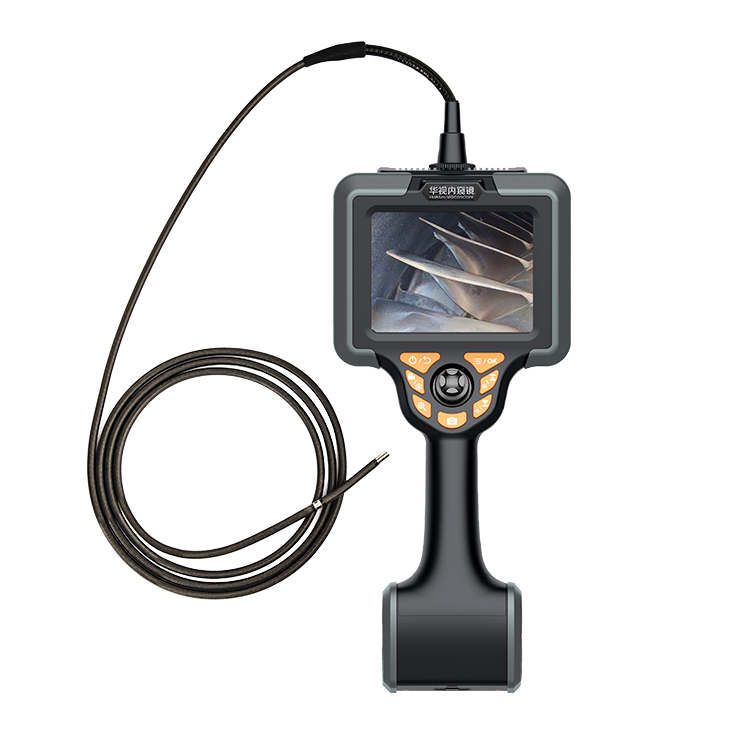
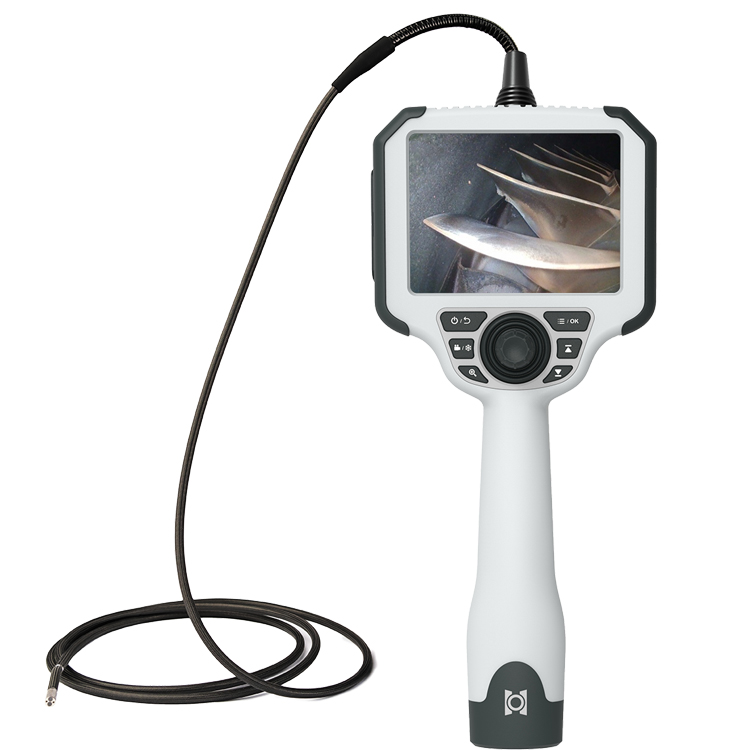
For example, a 4-way articulating side-view borescope can allow the operator to steer the distal tip in different directions while using the side-facing optical configuration to inspect internal surfaces.
This can be valuable when inspecting:
Curved passages
Complex cavities
Gearboxes
Turbine structures
Engine components
Internal weld areas
When selecting an articulating side-view borescope, consider the actual articulation range, probe diameter, probe length, minimum bending radius, tip response, and viewing configuration.
8. How to Choose a Side-View Industrial Borescope
Viewing direction is only one part of the selection process.
8.1 Probe Diameter
Choose a diameter that fits the available access opening while providing the required imaging and mechanical performance.
Smaller probes provide better access to restricted openings, while larger probes may offer advantages in imaging, illumination, mechanical strength, or feature integration depending on the design.
8.2 Probe Length
Select the length according to the distance between the access point and the inspection target.
Common configurations include:
1 m
2 m
3 m
5 m
10 m
20 m
The appropriate length depends on the actual inspection path.
8.3 Articulation
For straight passages, articulation may be less important.
For curved or complex structures, articulation can significantly improve camera positioning.
A 4-way articulating configuration can provide control in multiple directions, but the actual steering range should always be checked against the manufacturer's specifications.
8.4 Camera Resolution
Higher camera resolution can provide more visible detail, but resolution alone does not determine image quality.
Also evaluate:
Image sensor
Optical system
Lighting
Working distance
Image processing
Display quality
A well-balanced imaging system is more important than simply selecting the highest megapixel specification.
8.5 Illumination
Internal industrial structures can be dark, reflective, oily, or unevenly illuminated.
A suitable illumination system is therefore essential for side-view inspection.
The lighting system should provide sufficient illumination at the actual working distance without excessive glare or overexposure.
8.6 Recording and Documentation
For professional NDT and maintenance applications, image and video recording can be important.
Consider whether the system supports:
Photo capture
Video recording
Image storage
Inspection notes
Measurement functions
Data export
Inspection reporting
Good documentation allows inspectors to preserve visual evidence and compare findings during future inspections.
9. Side-View Borescope Selection Checklist
Before purchasing a side-view borescope, confirm the following:
Inspection Target
Are you inspecting an internal wall?
Is the target parallel to the probe?
Do you need forward-view inspection as well?
Probe
What is the maximum available access opening?
What probe diameter is required?
How deep is the inspection area?
What probe length is needed?
Steering
Is articulation required?
Do you need 2-way or 4-way articulation?
What is the actual articulation range?
Imaging
Is the camera resolution sufficient?
Is the side-view image clear at the expected working distance?
Is the illumination adequate?
Viewing Direction
Forward view?
Side view?
Dual view?
Fixed or switchable viewing direction?
Environment
Water or dust exposure?
Oil or chemical exposure?
High-temperature conditions?
Hazardous-area requirements?
Documentation
Photo recording?
Video recording?
Measurement?
Inspection reports?
10. Common Mistakes When Choosing a Side-View Borescope
Mistake 1: Choosing a Side-View Probe for Every Application
Side-view is not automatically better.
If the primary target is directly ahead of the probe, a forward-view system may be more appropriate.
Mistake 2: Looking Only at Viewing Direction
A 90° viewing direction does not guarantee good inspection performance.
Probe diameter, optics, lighting, articulation, working distance, and image processing also matter.
Mistake 3: Ignoring Probe Geometry
The probe must physically reach and navigate the inspection area.
Always evaluate:
Access opening + probe diameter + probe length + bending radius + articulation
Mistake 4: Assuming Side View Eliminates All Blind Areas
Side-view can significantly improve visibility of internal walls and side-facing surfaces, but no borescope configuration can guarantee zero blind areas in every geometry.
Inspection coverage depends on probe position, viewing direction, articulation, lighting, surface geometry, and operator technique.
FAQ: Side-View Borescope
Q1: What is the main difference between a side-view and a standard borescope?
A standard forward-view borescope primarily looks ahead of the probe, while a side-view borescope uses a side-facing optical configuration, typically around 90°, to inspect surfaces beside the probe.
Q2: Is a side-view borescope better for pipeline inspection?
It can be particularly useful when the main inspection target is the internal pipe wall.
A forward-view system is more suitable when the main target is at the end of the pipeline or passage. For comprehensive pipeline inspection, the appropriate configuration depends on pipe geometry and inspection requirements.
Q3: Should I use a side-view or forward-view borescope for turbine blades?
It depends on the inspection target.
Forward view can be useful for surfaces directly ahead of the probe, while side view can help inspect blade surfaces and other areas positioned beside the insertion path.
For complex turbine inspections, dual-view systems can provide greater flexibility.
Q4: Is a dual-view borescope worth choosing?
If your inspection tasks regularly involve both forward-facing and side-facing surfaces, a dual-view system can reduce the need to change probes and make the inspection workflow more flexible.
Q5: Can a side-view borescope have 4-way articulation?
Yes. Side-view optics and probe articulation are independent functions and can be combined in the same industrial videoscope.
A 4-way articulating side-view borescope can provide both directional steering and side-facing inspection capability for complex internal structures.
Q6: Can a side-view borescope measure defects?
Some industrial borescopes support measurement functions, including 3D measurement on selected models.
Whether measurement is available depends on the specific system and camera configuration. Measurement accuracy also depends on factors such as calibration, working distance, surface characteristics, optics, and measurement technology.
WorldNDT Side-View Borescope Solutions
WorldNDT provides industrial borescope solutions for inspection applications where internal walls and side-facing surfaces are difficult to observe with a conventional forward-view camera.
Depending on the application, the appropriate system can be configured around:
Side-view or dual-view optics
Probe diameter
Probe length
4-way articulation
Camera resolution
Illumination
Recording
Measurement capability
Environmental requirements
Side-view inspection can be especially useful for pipelines, cylinder walls, gearboxes, turbine components, weld areas, internal bores, molds, and complex machinery.
For applications where both forward and side-facing targets must be inspected, a dual-view industrial videoscope can provide greater flexibility without requiring a separate probe for every inspection direction.
Conclusion
A side-view borescope is designed for one of the most important challenges in industrial internal inspection: seeing surfaces that are positioned beside the inspection path rather than directly in front of the camera.
Its approximately 90° viewing direction makes it particularly useful for inspecting:
Pipe walls
Cylinder walls
Turbine blade surfaces
Gear teeth
Weld areas
Internal bores
Cavity walls
The choice between forward view, side view, and dual view should be based on the actual geometry of the inspection target.
For simple forward-facing inspection, a standard forward-view borescope may be sufficient. For internal wall inspection, side-view can provide better alignment with the target surface. For complex applications requiring both directions, a dual-view borescope can provide a more flexible inspection solution.
The most effective system is not necessarily the one with the most features, but the one that provides the right combination of viewing direction, probe diameter, probe length, articulation, imaging, illumination, and documentation functions for the specific inspection task.