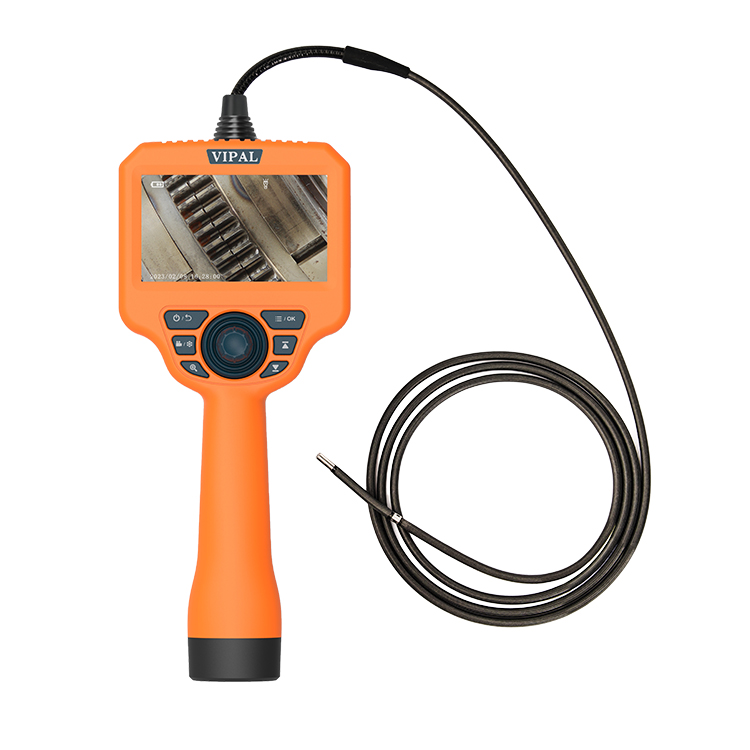

Borescope Inspection for Bearings: How to Inspect Bearings Without Disassembly
Category: News-
On: 2026-09-10
Bearings are critical components in gearboxes, motors, turbines, pumps, compressors, and other industrial machinery. Bearing damage can lead to vibration, overheating, noise, reduced efficiency, and eventually unexpected equipment failure.
Traditional bearing inspection often requires partial or complete disassembly. This can increase maintenance time and may require equipment shutdown.
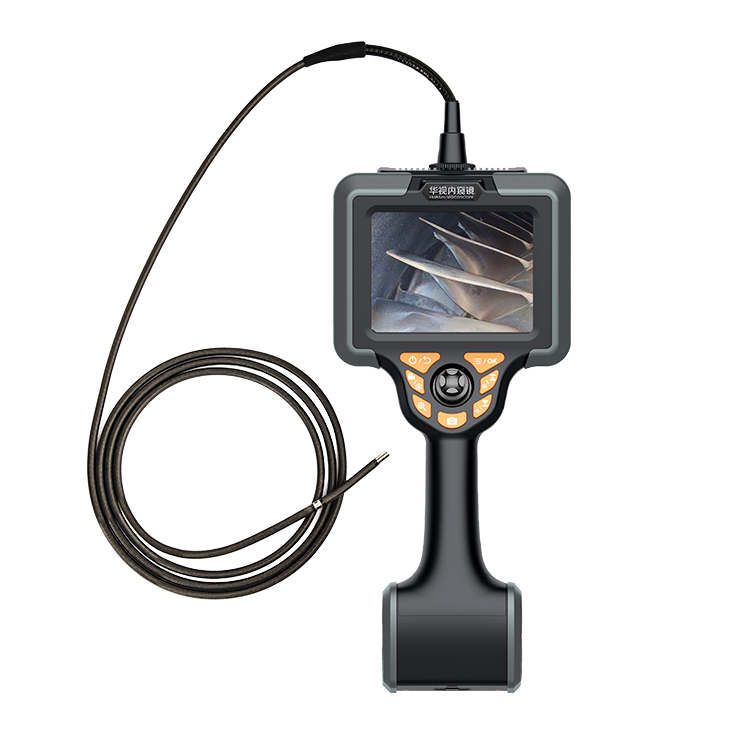
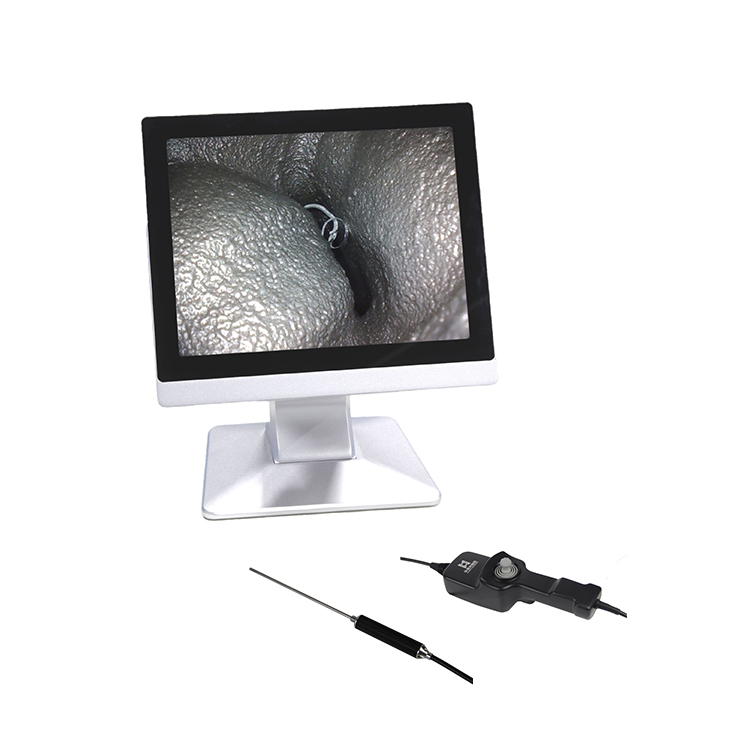
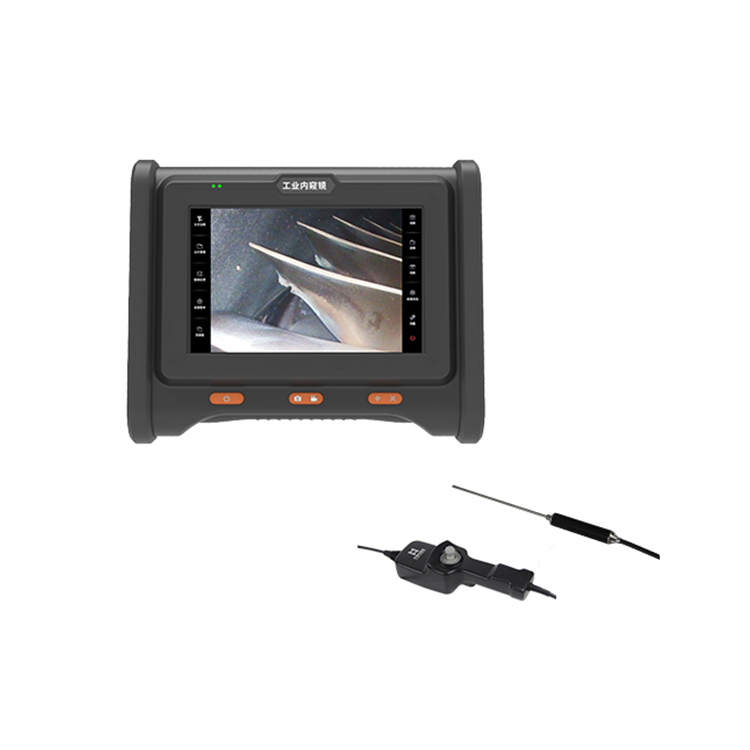
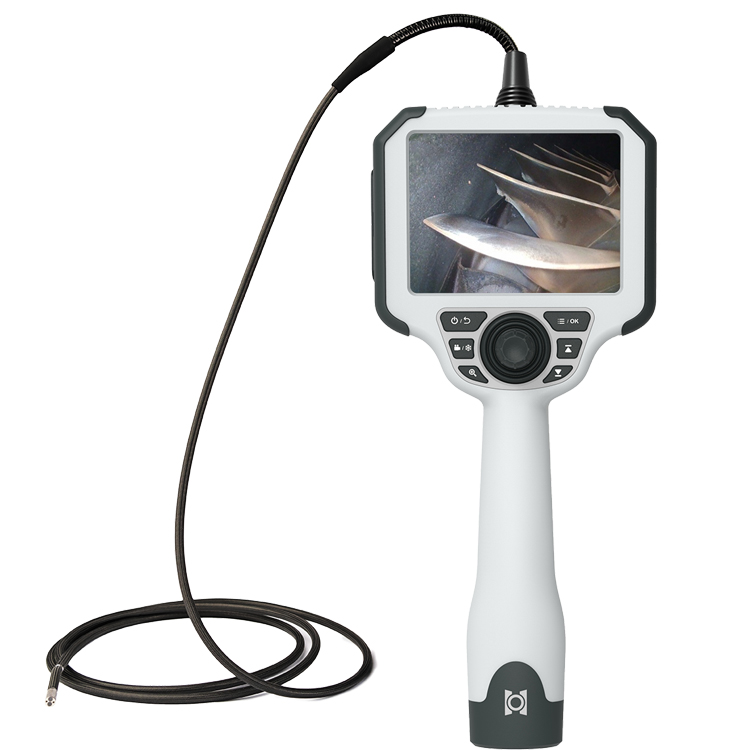
A bearing inspection borescope provides another option. By inserting a small-diameter camera through an existing access point, inspection personnel can visually examine accessible bearing surfaces without removing the entire assembly.
This approach is particularly useful when equipment downtime needs to be minimized.
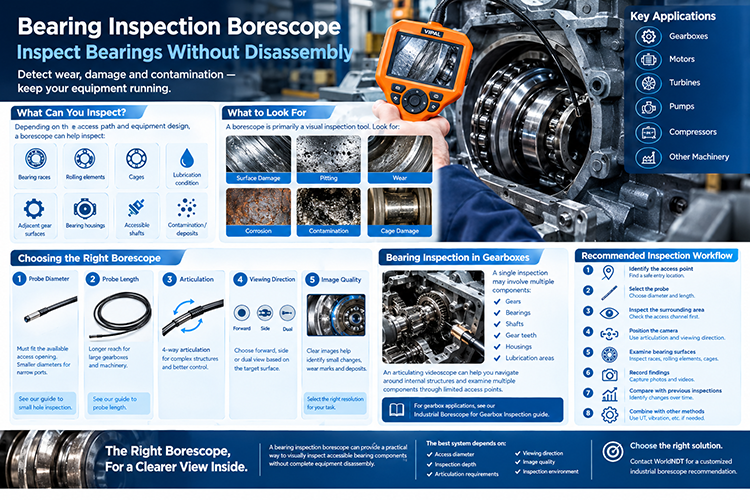
What Is Bearing Borescope Inspection?
Bearing borescope inspection is a form of remote visual inspection (RVI) in which an industrial videoscope is inserted into equipment to observe bearing components and surrounding areas.
Depending on the equipment design and access conditions, a borescope may help inspect:
Bearing races
Rolling elements
Cages
Lubrication conditions
Adjacent gear surfaces
Bearing housings
Accessible shafts
Signs of contamination or deposits
The exact inspection area depends on the available access path and the geometry of the equipment.
What Can You Look for During Bearing Inspection?
A borescope is primarily a visual inspection tool. Inspectors may look for visible indications such as:
1. Surface Damage
Visible scratches, scoring, dents, or abnormal surface marks may indicate mechanical damage.
2. Pitting
Small pits or damaged areas on bearing surfaces can be important visual indications, particularly when inspecting heavily loaded components.
3. Wear
Abnormal wear patterns may indicate prolonged operation, lubrication problems, contamination, or alignment issues.
4. Corrosion
Rust, staining, or corrosion-related surface changes may be visible on accessible components.
5. Contamination
Foreign particles, deposits, or degraded lubricant may be visible around the bearing.
6. Cage Damage
If the bearing cage is accessible from the inspection angle, inspectors may look for deformation, cracking, or other visible abnormalities.
A borescope inspection does not replace vibration analysis, dimensional inspection, or other condition-monitoring methods when those methods are required.
Why Use a Borescope for Bearing Inspection?
The main advantage is access without extensive disassembly.
A suitable industrial videoscope can help inspectors:
Reduce inspection time
Reduce unnecessary disassembly
Inspect difficult-to-access components
Record photos and videos
Compare inspection results over time
Document visible defects
Support preventive maintenance decisions
For large gearboxes and industrial machinery, a long-reach probe and flexible articulation can be especially useful.
Choosing the Right Borescope for Bearings
Several factors should be considered when selecting an inspection system.
Probe Diameter
The probe must fit through the available access opening.
For small access ports, a small-diameter probe may be required. For more information, see our guide to industrial borescopes for small holes.
Probe Length
Large gearboxes and machinery may require a longer probe to reach the inspection area.
See our guide to borescope probe length when determining the required insertion distance.
Articulation
If the bearing cannot be viewed directly from the access point, articulation can help position the camera.
A 4-way articulating borescope can provide greater control when inspecting complex internal structures.
Viewing Direction
A forward-view camera is useful for inspecting surfaces directly ahead of the probe.
A side-view or dual-view system can be advantageous when the target surface is perpendicular to the insertion direction.
Image Quality
Good image quality helps inspectors identify small surface changes, wear marks, deposits, and other visible indications.
The appropriate resolution should be selected according to the inspection task rather than simply choosing the highest specification available.
Bearing Inspection in Gearboxes
Gearboxes are one of the most common applications for internal bearing inspection.
A single inspection may involve several components, including:
Gears
Bearings
Shafts
Gear teeth
Housings
Lubrication areas
An articulating industrial videoscope can help inspectors navigate around internal structures and examine multiple components through limited access points.
For gearbox applications, see our Industrial Borescope for Gearbox Inspection guide.
Recommended Inspection Workflow
A practical bearing inspection can follow these steps:
Step 1 — Identify the access point
Determine where the borescope can safely enter the equipment.
Step 2 — Select the probe
Choose the appropriate diameter and length according to the access path.
Step 3 — Inspect the surrounding area
Before reaching the bearing, check the access channel and surrounding components.
Step 4 — Position the camera
Use articulation and suitable viewing direction to position the camera.
Step 5 — Examine bearing surfaces
Inspect accessible races, rolling elements, cages, and surrounding components.
Step 6 — Record findings
Capture photographs and videos of relevant areas.
Step 7 — Compare with previous inspections
Historical images can help identify changes over time.
Step 8 — Combine with other inspection methods
If a visible indication requires further evaluation, use the appropriate complementary inspection or condition-monitoring method.
Conclusion
A bearing inspection borescope can provide a practical way to visually inspect accessible bearing components without complete equipment disassembly.
The best system depends on the access diameter, inspection depth, articulation requirements, viewing direction, image quality, and inspection environment.
For gearbox, motor, turbine, pump, and machinery applications, selecting the right industrial videoscope can make routine visual inspection faster and easier to document.
Related WorldNDT Solutions:
Industrial Borescopes
G10 Industrial Videoscope
G20 Measurement Videoscope
Gearbox Inspection
Borescope Probe Diameter
Borescope Probe Length
4-Way Articulation
Need help selecting a bearing inspection system? Contact WorldNDT for a customized industrial borescope recommendation.